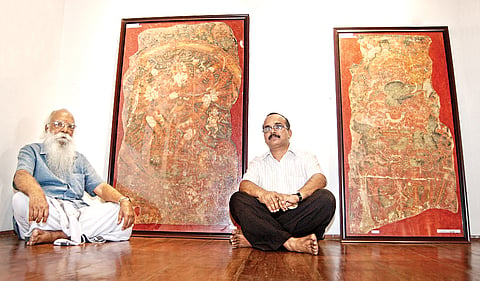

On November 30, 1970, a massive fire broke out in the Sree Krishna temple at Guruvayur. As a result, several mural paintings were damaged. When renowned mural painter KK Warrier read about the news, he rushed to the temple, accompanied by two artists, Sreenivasan and Soman. “We traced the painting on paper so that we knew what the drawing was like,” says Warrier. Then in 1986, the Guruvayur Devaswom, which oversees the temple, showed an interest in preserving the paintings. Usually, when there is a renovation, the old works are scraped off. Then new drawings are put on the same wall. “But I wanted to preserve the original compositions,” says Warrier. “These have been done by masters like Pulakkat Raman Nair and his disciples.”
In the ancient method of mural painting, first the wall is plastered. Thereafter, there is a coating of lime and coconut water. “In fact, there are 28 coats,” says Sasi. “It becomes thicker than paper. It is on this base that the painting has been done.”
Warrier, 78, accompanied by his son, Sasi, tried various techniques to remove the paintings, but none worked, till, after four months of experimentation, they finally hit upon a foolproof method. “It is a chemical process, and we want to keep it a secret,” says Sasi with a smile. “We have applied for a patent.”
In their method, they can take the painting off, along with the underlying layer. Then it is placed on a wooden board and for the background, the ochre-red colour, which is a must in all mural paintings, is painted in.
Interestingly, they got the largest painting, 6 x 4 ½ ft., from a house on the periphery of the Guruvayur temple. The Warriers wanted to save it. The owner, Nharakkat Pisharam, had one request: he wanted a photocopy so that he could hang it in his new home. “In this work, Hanuman is reading the Ramayana to Rama,” says Warrier.
The earliest painting—at the Karivellur Puthoor Siva temple at Kannur—is 400 years old. In 2002, the temple authorities were planning a renovation. “When the news broke out in the media that such old paintings were going to be destroyed, we got in touch,” says Warrier. “We completed the job in four days.”
In total, there is a collection of 98 paintings that were displayed at an exhibition in Kochi recently. “We wanted to sensitise the public about this treasure trove,” says Sasi. “There are many non-Hindus who will not be able to enter temples to see these works. So this is a chance for them to view them.” The Warriers also want temple authorities across the state to view the display.
And with the dedication, the unlikely combination of father and son, both well-known mural painters, have taken the onerous task of preserving a particular niche of Kerala’s cultural heritage.