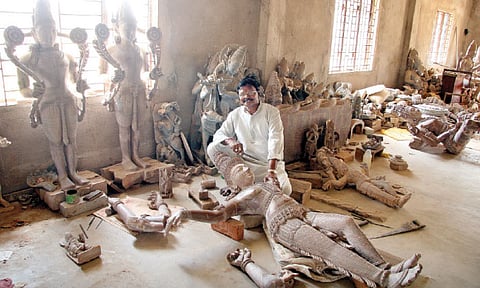

At the Raghunath Crafts Museum, sprawling over two acres of land at Sisupalgarh on the outskirts of Bhubaneswar, a thatched shed stands on one side with stone blocks lying all around. The shed reverberates with the sounds of chisel and hammer. On the other side are thousands of sculptured statues of deities in different postures and of sizes.
Bathed in the afternoon glow, the intricately crafted figures are witness to the artistry of Raghunath Mohapatra, a pioneer figure in the world of sculpture. These works will soon be placed inside a three-storeyed museum that Mohapatra is currently setting up near his workshop.
The legendary sculptor was this year bestowed with the Padma Vibhushan, India’s second-highest civilian award. Mohapatra, 67, is the third Odia after late Odissi dancer guru Kelucharan Mohapatra and litterateur Sitakant Mahapatra, to bag this honour. During the past five decades, Mohapatra’s fame has travelled far and wide for his distinct carving style that comes out clearly in his magnificent masterpieces. He is also a noted architect. Mohapatra confesses he hasn’t studied anything about wielding a chisel or a hammer in any art school. He ensures perfection in his creations through measurement, symmetry and visualisation.
Born to the Viswakarma family in Puri’s Pathuria Sahi, Mohapatra studied till Class III. He started working with stone at the age of eight. A dropout from the Daitapada Sahi High School in Puri, Mohapatra learnt the art of stone carving from his grandfather Aparti Mohapatra, a sculptor who worked with the royal family of Puri for upkeep of 12th century-old Shri Jagannath Temple at Puri.
“My teacher once beat me up for not being able to solve a maths equation. Since I was the only grandson in my family, my grandfather then asked me to quit education and carry on with the family’s legacy,” Mohapatra recalls.
It was in the 1960s when two officials of the Handicraft Training and Designing Centre, Bhubaneswar, saw a young Mohapatra carving a beautiful ‘devadasi’ out of stone at the verandah of his house in Pathuria Sahi, and they decided to hire him. “They had then bought the ‘devadasi’ sculpture from me at `22 and also offered me a job in the Handicraft Training and Designing Centre. I agreed and some months later I was regularised as a master craftsman. I was 20 then,” he reminisces.
In 1968, Mohapatra got the National Award for an 18-inch Konark Horse that he carved out of black stone. During the National Games that was held in Barbati Stadium in Cuttack, he was selected by the government to carve an 18-feet Konark Horse sculpture that today stands guard near the western gate of the stadium. Another similar 18-feet-long, 15-feet-high Konark Horse carved by him was installed at the Master Canteen Square, a popular landmark in Bhubaneswar.
His talent came to limelight in the 1970s when he created a six-feet-tall grey stone statue of sun god which is now being displayed at the Central Hall of Parliament. “The statue, which I created within 20 days, was then Odisha’s representation in the Parliament building,” he said. For this, he received the prestigious Padma Shri in 1974. In 2001, he was honoured with the Padma Bhushan. The master sculptor hasn’t looked back since then. His other famous works include two 15-feet Buddha statutes in white sandstone at the historic Dhauligiri Shanti Stupa near the city; a gigantic lotus of 30 feet-by-30 feet in a single black granite stone at prime minister Rajiv Gandhi’s samadhi at Vir Bhumi, Rajghat; the 15-feet-tall Mukteswar Gate in red sand stone at Surajkund; three 20-feet-high statues of Buddha in white sandstone at the Buddhist Monastery, Ladakh; a 15-feet Ashokan Pillar at Osaka, Japan; and a wooden Buddha at the Buddha Temple, Paris.
One of his most ambitious works is a modern temple that is being built as per the ancient Odishan temple architecture at Tara Tarini hill shrine in Ganjam district. At present, he is on the job of building Jagannath temples in Nigeria, Bangalore, Balasore, a Laxmi temple in Visakhapatnam and a Sai temple in Jharsuguda.
Besides, he is working on creating a strong workforce of sculptors who are able to take care of Odisha’s rich temple legacy. “I am currently training around 500 workmen from Uttar Pradesh, Rajasthan and within Odisha in traditional sculpting and temple designing at my workshop,” says Mohapatra. His workers rarely use machines, preferring to use their hands.
Mohapatra speaks of stone with passion. “Stones constantly change,” he observes. And, working with the hardy blocks, he says, has taught him patience. “The designs have to be done right the first time. There is no second chance for perfection,” he says.
The master sculptor, meanwhile, is in talks with the Odisha government to give shape to his most important dream, a second Konark Temple in Odisha.
