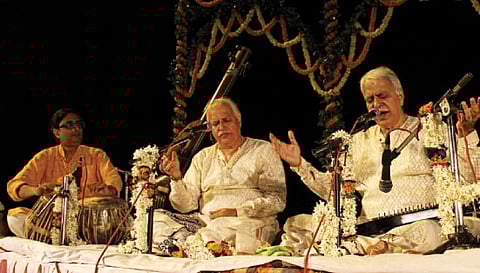

It takes you a journey along the meandering Ganges to discover the most pristine meends in Raag Shree’s descent. World-renowned vocalists Pandit Rajan and Sajan Mishra shorten the distance between this world and the other world for a listener, even sooner, when they are performing on the ghats of Benaras. The maestros who performed at the Benaras Utsav earlier this month were honoured with Pandit Omkarnath Thakur Memorial Awards by the Government of Gujarat last week.
On a nippy evening at the Benaras Festival, at a concert held on the banks of the sacred river at the Assi Ghat, the Mishras travelled three thhats, from Purvi, to Marwa to Bhairavi (for a bhajan), in a flow, as serene as the Ganga’s. Benaras, also the home and the symbolic musical bastion for the Mishras who have roots in the historical locality of Kabir Chaura, reintroduce you to these great maestros of Benaras Gharana, the ragas they perform, and the melodies’ purest and surreal avatars—even the parallel antiquity in Raag Shree. Mishra’s Kahey ab tumn aaye ho in Sohini discarded the brooding viraha momentarily to wear a lonesome yet self-adulatory and proud expression.
On the banks of Ganges in Benaras, even the rhythm cycles Jhaptaal and Ektaal seem to honour the river’s pace. Says Pandit Sajan Mishra, “Music has broken class barriers in Benaras. People, irrespective of what profession they follow, have imbibed music and the arts in their daily lives. The Ustads and Pandits performed on daises and occasions. But there was no discrimination on who could learn a bandish. The boatman, masseur, cobbler, and hairdressers would sing impeccable taans and compositions beautifully after hearing the greatest of musicians practise or perform ragas in daily life.”
In its maiden year, Benaras Utsav, an independent effort by a bunch of citizens in the culturally awakened “Kashi” looked promising. The festival would make a place for itself provided the organisers suffuse a larger share of performing arts, including baithaks and talks on the intricacies of classical, semi-classical and folk music and performances of traditional dance, rituals and local theatre into this noble effort in the coming years. Pandit Sajan Mishra says, “Ustad Bismillah Khan propagated the Ganga-Jamuni essence of Benaras. The city soaked in the musical sensibilities of geniuses from across India. Many maestroes, including those from the Carnatic tradition came here to learn and perform.”
Benaras is about journeys—the journey between truth and mundane; between spiritual and superficial; between a raga and the raga-swaroop. “On one of the many occasions that Hariji (world-renowned flute maestro Pandit Hari Prasad Chaurasia) was in Benaras, he came across something beautiful at the ghats. A person broke into a bandish while giving him a massage. Hairiji paid his respects to him. It was a very emotional moment. The man said he had picked the bandish from Pandit Mahadev Mishraji,” adds Pandit Sajan Mishra.
The Benaras Utsav could explore its desired canvas with support from the state government. “One of the festivals organised in Benaras is not in tune with the local sensibilities. There’s nothing wrong about inviting singers from the Mumbai film industry to perform at a music festival in Kashi. But music and culture festivals should be organised keeping in mind the dignity of this ancient city and the aesthetics its antiquity commands,” add the maestros. Its classicism is what makes Benaras the destination for music devotees. A packed morning concert of Carnatic legend TV Sankaranarayan we had attended in 2003 at Assi Ghat was proof. The Benaras Utsav could beautifully walk this path.