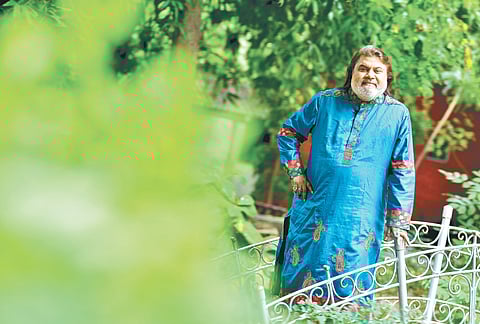

Ananth Vaidyanathan, 57, is the maker, shaper and the tuning instrument of the voice. The Chennai-based voice therapist has trained more than 1,000 students, including many senior artistes and reality show contestants in voice techniques. He will be writing a book on the art of unlocking the singing voice and his musical experience.
He says, “I hope to reach the youngsters through my book on my experiences and musicianship. I have trained many a reality show contestants and I feel that there are many singers who suffer from unrecognised voice problems. Instead of grooming them, the reality shows make them feel overrated.”
Vaidyanathan wants to revolutionalise the process of voice training. “I want to break the so-called ‘grammar’ when it comes to teaching music. I want to begin with vruthams, shlokas and simple verses, instead of those complicated varnams,” he adds. During a very systematic process of traning and practice, Vaidyanathan puts the voice into use in different life situations. “Any singer should develop a voice-friendly singing. The first step begins with voice awareness.” He updates himself constantly to bridge the expectations of today’s youth and doesn’t want to be known as a “voice therapist”. He says, “I am a musician-cum-guide who brings out a vocalist’s musical skills after understanding and analysing his or her ability. I’m like a facilitating instrument.” Training a voice is a long process.
Vaidyanathan has been approached by vocalists who complain that their voices break when they sing in the high pitch. He suggests simple breathing exercises. “Voices tend to break because one loses breath. Simple breathing exercises bring a lot of improvements.” He also corrects a lot of approaches related to singing. The first and the most common one—singing from the throat. “The singing has to happen from the lower abdomen. It prevents you from straining your vocal cord, especially when you approach the higher notes,” he adds.
Vaidyanathan’s stepping into this profession was sort of accidental. He was advised to sing “softly” after he lost his ‘speaking voice’ while learning music. “I got my voice back, thanks to Sunil Bose, a teacher at Kolkata’s ITC Sangeet Academy. He taught me a technique that made me find the voice again. I wasn’t satisfied initially, but I tried to understand how a singing voice actually worked.” He adds, “My foray into voice culture began with a thirst for knowledge. Professor Frederick Husler (a well-known teacher who lives in Holland and imparts voice and movement lessons) has been a guide. I have also referred to a lot of material by experts Ruggerberg and Calatin.”
Does the voice break with age? “Singing and practicing are different things. When you sing, you modify the voice to make it pleasing for the listeners. But when you practise, you should be clear, not loud. Lataji (Mangeshkar) and Parveen Sultana sound perfect even at this stage of their singing careers. You must take proper care of your throat,” he concludes.
The turning Point
LOST AND FOUND: The man who has trained many senior classical vocalists had lost his voice while learning Hindustani music. Ananth was advised to sing “softly” after he lost his “speaking voice”. Sunil Bose, a teacher at Kolkata’s ITC Sangeet Academy, taught him a technique that made him find the voice again. The experience made him understand how the singing voice works.
Pearls of wisdom
Some tips and areas of focus from Ananth Vaidyanathan’s classroom:
■ Never sing from the throat. Singing has to happen from the lower abdomen.
■ Singing from the abdomen prevents you from straining the vocal cords—especially in the higher octaves.
■ Become aware of your voice. Distinguish between tonal and mechanical voice dimensions.
■ Understanding and achieving production of tones like head voice, chest voice.
■ Understand the role of breathing in singing and the depth of singing.
■ Improvising, and the articulation of songs and speech come gradually.
■ Analyse the dynamics of the voice without straining it.
■ Patience is the key. The voice is achieved through a physiologically conducive process voice production and culture.
■ Solving breathing problems is the golden route to a fine texture.
■ Take proper care of your throat.