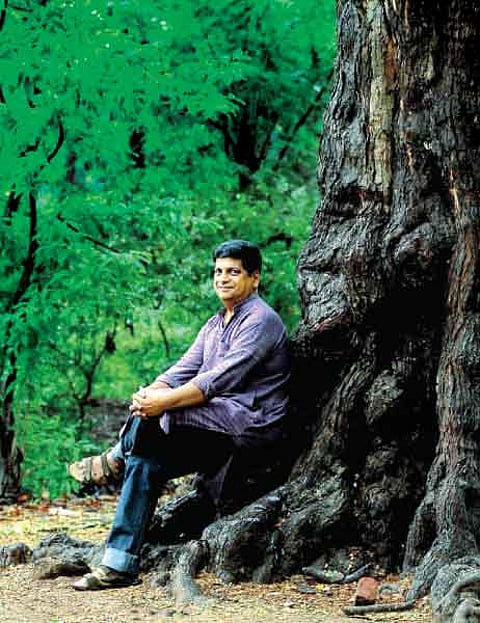

He breaks the ice with dance and drama. Thrissur -based Kalamandalam Mohanakrishnan, the well known guru and performer of Ottamthullal, the performing art from Kerala, has used the most powerful alternative to language — abhinaya, the art of expression, to reach the non-Malayali audience for decades. Mohanakrishnan performed at the Spic Macay 2nd International Convention held at IIT-Madras, recently.
Enacting excerpts from Mahabharat, where Bheemasenan blesses Paanjali, he invited a woman from the audience to the dais. He picked up a book that was placed on the dais and handed it over to the woman to explain Bheemasenan’s act. He says, “Usually, women in the audience are hesitant to come to the stage.” He usually performs excerpts from Mahabharatam, Ramayanam and Bhagavatham. “To quash the language barrier, I brief my audience about the story I perform. Then, I explain a little about Thullal and how it is performed. I enact the various characters. For portraying Hanuman as a vanaran, I scratch all over the body and hop around — the usual acts of a monkey. For Beeman, I walk in a particular style. Similarly for Paanjali, in a different style,” he adds.
Mohanakrishnan believes that he was ordained to be an Ottamthullal artiste. “No one in my family was associated with Ottamthullal. Even as a child, I displayed a keen interest in the art. My parents encouraged me and I began pursuing it after completing school education,” he says. His guru Gopinatha Prabhu accompanied him in the music at the concert. “The importance is not restricted to one person. My other co-artistes will play an equal part,” he adds.

Ottamthullal, the art that evolved in the 18th century, was developed by Malayalam poet and satirist Kunchan Nambiar. “The most gratifying part is that the art’s social commitment hasn’t changed. Performance of art has a purpose. It is to engage the audience in a social dialogue,” he adds. “Interestingly, the dance form has also been referred to as the ‘poor man’s Kathakali”. It is inspired by Chakyar Koothu (a monologue-oriented performing art). “Unlike many other art forms, Ottamthullal uses humour, as against text or complex music to engage the audience. According to Mohanakrishnan, it is a judicious mix of the abhinayas detailed in the Natya Shastra. While Kathakali and Mohiniyattam, have taken giant strides, Ottamthullal has a limited reach. The artiste hopes for change. “The audience is delighted to witness a performance that’s simple and yet makes an impact,” he says.
The dance form was predominantly performed in temples in the early days. Institutions like Kalamandalam in Thrissur, Kerala, have played a pivotal role in popularising the art form.
Mohanakrishnan has been training students in Ottamthullal at Kalamandalam since 2002. He started imparting lessons after learning the art at the institution for eight years. He has seen a ring side view as a teacher and a performer. “Earlier, it was a ‘guru-shishya sampradayam’. In those days, arts were learnt by observing the guru. Nothing was ‘taught’ specifically. Today, we have a curriculum and a time frame for both teaching and learning. However, even today, the guru-shishya bond is the same,” he says.
Ottamthullal is inspired by Natya Shastra (the treatise written by Sage Bharata) and has borrowed the concept of costumes and make up from Kathakali. “Kathakali’s make-up draws the attention of the viewer. Since Ottamthullal was aimed to draw the common man towards art, it required visual elements. The audience play a major role. They are not mere spectators. As long as they are with the performers they have a role to play,” he adds.
The other thullals that also derive their names from castes in Kerala—Seethankan Thullal and Parayan Thullal are slower in tempo. The important elements of Ottamthullal include a percussion instrument, the maddalam and cymbals. The tunes are based on (Carnatic) ragas. “The compositions we use in performance are from Kunchan Nambiar’s vast repertoire. There is a variety of emotions portrayed. Ottamthullal extends beyond the grammar of the Natya Shastra and the detailing of kathakali make-up,” adds Mohanakrishnan.