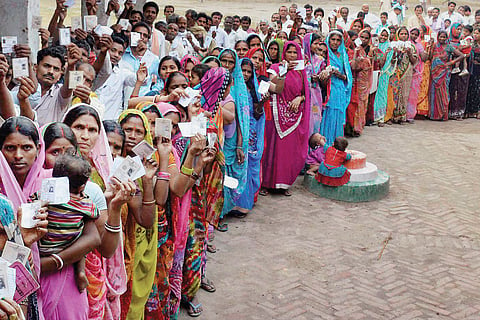

Beyond the Modi wave, a greater wave has swept India. The E-Wave. In 502 constituencies audited, the turnout has been an unprecedented record show—over 66 per cent (provisional data till the eighth phase). Elections 2014 has turned out to be the greatest battle of the ballot in India’s electoral history, nay world history, irrespective of its outcome. It is already 2 per cent higher than the previous record of almost 64 per cent clocked in 1984 on an extraordinary sympathy wave after Indira Gandhi was assassinated and son Rajiv elected the Prime Minister. The 2014 turnout is 8 per cent higher than 2009, another record. The highest increase in turnout so far has never exceeded 7 per cent. The percentages sanitise the raw power of numbers: of the 814 million eligible voters, 443 million voted. The turnout in E-2014 is 124 million, plus the population of the US which is 319 million. Even by global standards, Elections 2014 is a “Tsunami Turnout”.
A comparative study reveals that turnout has increased sharply in the northern and western states. In contrast, the increase is marginal in the south. In some of the North-eastern states—especially in Sikkim and Nagaland—the turnout has even fallen compared to 2009. In Tripura and Manipur, it has hardly increased. Goa registered the highest growth in turnout: 22 per cent, followed by Rajasthan, Gujarat and Chhattisgarh—around 15 per cent. All four high turnout states are BJP-ruled states. The next are Delhi, Jharkhand, Uttar Pradesh, Bihar, Mizoram, Assam and Madhya Pradesh—all above the all India average of 8 per cent hike. In Uttar Pradesh and Bihar, the rise was almost 12 per cent. West Bengal, at almost 82 per cent, registered a marginal 3 per cent increase compared to 2009 but it had approached saturation levels anyway. Likewise, Odisha’s 70 per cent turnout rose by 8 per cent over 2009. However, Punjab bucked the 2014 trend with just a 2 per cent increase. In the south, Kerala and Tamil Nadu turnouts, with nearly 72 per cent, increased only by a couple of points. In divided Andhra Pradesh, the turnout increase was merely 3 percentage points, while Karnataka and Maharashtra registered 8 percentage points. Says Union minister and West Bengal Congress chief Adhir Choudhury, “The reason for brisk polling varies from place to place, issue to issue. General perception is that it is a vote against the local government, anti-incumbency of the local MP, it could be a vote for change or a vote for survival in a politically vitiated atmosphere.”
What story does this comparative state-wise data on turnouts tell? The four congruent BJP-ruled states of Goa, Rajasthan, Gujarat and Chhattisgarh registered record turnout increases ranging from 15 per cent to 22 per cent suggesting that voters stayed loyal. Rajasthan particularly displayed an unprecedented level of 75 per cent turnout in the Assembly polls in 2013 winter, showing the saffron wave still prevailed in summer. Nagaur, Kota and Jalore registered the highest increases. This is partly due to increasing literacy levels and more significantly owing to the Modi wave. Another BJP stronghold Gujarat registered a turnout of 61 per cent, an increase of 13 per cent. But a caveat applies here: Lok Sabha polling patterns in the past three elections have not followed the Assembly trend closely. The Congress shows better in the Lok Sabha compared to the Assembly polls. Yet, a sharp turnout climb would help Narendra Modi, who has A comparative study reveals that turnout has increased sharply in the northern and western states. In contrast, the increase is marginal in the south. In some of the North-eastern states—especially in Sikkim and Nagaland—the turnout has even fallen compared to 2009. In Tripura and Manipur, it has hardly increased. Goa registered the highest growth in turnout: 22 per cent, followed by Rajasthan, Gujarat and Chhattisgarh—around 15 per cent. All four high turnout states are BJP-ruled states. The next are Delhi, Jharkhand, Uttar Pradesh, Bihar, Mizoram, Assam and Madhya Pradesh—all above the all India average of 8 per cent hike. In Uttar Pradesh and Bihar, the rise was almost 12 per cent. West Bengal, at almost 82 per cent, registered a marginal 3 per cent increase compared to 2009 but it had approached saturation levels anyway. Likewise, Odisha’s 70 per cent turnout rose by 8 per cent over 2009. However, Punjab bucked the 2014 trend with just a 2 per cent increase. In the south, Kerala and Tamil Nadu turnouts, with nearly 72 per cent, increased only by a couple of points. In divided Andhra Pradesh, the turnout increase was merely 3 percentage points, while Karnataka and Maharashtra registered 8 percentage points. Says Union minister and West Bengal Congress chief Adhir Choudhury, “The reason for brisk polling varies from place to place, issue to issue. General perception is that it is a vote against the local government, anti-incumbency of the local MP, it could be a vote for change or a vote for survival in a politically vitiated atmosphere.”
What story does this comparative state-wise data on turnouts tell? The four congruent BJP-ruled states of Goa, Rajasthan, Gujarat and Chhattisgarh registered record turnout increases ranging from 15 per cent to 22 per cent suggesting that voters stayed loyal. Rajasthan particularly displayed an unprecedented level of 75 per cent turnout in the Assembly polls in 2013 winter, showing the saffron wave still prevailed in summer. Nagaur, Kota and Jalore registered the highest increases. This is partly due to increasing literacy levels and more significantly owing to the Modi wave. Another BJP stronghold Gujarat registered a turnout of 61 per cent, an increase of 13 per cent. But a caveat applies here: Lok Sabha polling patterns in the past three elections have not followed the Assembly trend closely. The Congress shows better in the Lok Sabha compared to the Assembly polls. Yet, a sharp turnout climb would help Narendra Modi, who has won thrice as the chief minister in a row. After Morarji Desai, he is only the second prime ministerial candidate from the state. Vadodara, where Modi is contesting, has recorded one of the highest turnout increases. Similarly, Lucknow in Uttar Pradesh, where BJP president Rajnath Singh is contesting from, has registered a sharp rise. Meanwhile, Lucknow has been the BJP’s safest seat for the last quarter century. This time, with large sections of 4.5 lakh Muslims, 3.5 lakh Brahmins and 1.75 lakh Uttrakhandis supporting the Congress’s Rita Bahuguna Joshi, Rajnath might find it his toughest electoral battle. No doubt, Rajnath was found donning a skull cap while visiting a dargah to attract the sizeable Shia population, which voted for Atal Behari Vajpayee in the past. However, Aam Aadmi Party candidate Jaaved Jaffrey, a Shia, is bound to cut some of those key votes. Rajnath is banking on the fact that the other two candidates—Samajwadi Party’s Abhishek Mishra and Bahujan Samaj Party’s Nakul Dube—are Brahmins and are likely to affect some of Joshi’s Brahmin votes.
“In this jung (contest), the majority of the Akhliyat (minority community) are consolidated behind Joshi,” says Iqbal Siddiqui, a kebab café owner. What about Rajnath’s meetings with renowned Muslim clerics like Maulana Kalbe Sadiq, Maulana Khalid Rasheed and Maulana Kalbe Jawad in Lucknow? They seemed to back him; they call him the new Atal Behari Vajpayee. “But voting for Rajnath means electing Modi as the Prime Minister, not the new Atal Behari,” replies Siddiqui.
The efforts of the BJP and the RSS have driven up the turnout rate manifold in Lucknow. In 2014, it may look moderately high at 55 per cent, but in 2009, it was just 35 per cent. Ultimately the swing voters will determine Rajnath’s fate in an otherwise safe stronghold.
Speculations (with a small element of risk) reveal that the Modi wave is strongest in Goa, Gujarat, Rajasthan and tribal-dominated Chhattisgarh. Although Madhya Pradesh with 60 per cent turnout has not shown a dramatic rise over the 51 per cent recorded in 2009, yet the pattern of voting in this key Hindi heartland state, which was overwhelmingly in favour of the BJP in December 2013, is likely to follow the western states.
Maharashtra and Karnataka, both ruled by the Congress, have shown moderately high increase in turnout. What political picture does this trend convey? A year ago, Karnataka voted strongly in favour of the Congress in the Assembly polls. Reason: internal strife in the BJP, the tainted BS Yeddyurappa’s exit and the formation of a regional front. In 2014, south Karnataka, Yeddyurappa’s stronghold (he is contesting from Shimoga), polled higher than the north—Kolar and Chikkaballapur clocked almost 76 per cent; Udupi-Chikkamagalur approximately 75 per cent; Shimoga, Hassan, and Tumkur, Davanagere, Bellary, Haveri and Mandya above 70 per cent.
In Maharashtra, Pune and Maval—extremely tight contests —have clocked the highest increase in turnout rates. Both fall in the sugar belt, whose 12 seats—Pune, Sangli, Ahmednagar, Kolhapur, Hatkanangle, Shirdi, Shirur, Madha, Maval, Solapur, Baramati and Satara—are dominated by NCP boss Sharad Pawar. An intense campaign by the Shiv Sena-BJP combine in this belt threatens to turn the tables.
Low literate Uttar Pradesh and Bihar have always posted one of the lowest turnout rates in the past. However, the last decade has shown enormous growth in both literacy and turnout levels. Is the 12 per cent turnout increase in the 120 seats likely to go in the BJP’s favour? Or will the regional parties with their strong minorities support arrest the Modi wave? The result will determine who rules Delhi next and some crucial constituencies could be key indicators.
In Patna Saheb, where BJP’s sitting MP and Bollywood star Shatrughan Sinha fought RJD-supported Congress candidate and Bhojpuri film icon Kunal Singh, 54 per cent polling at face value does not appear very high. But compared to a pathetic 39 per cent in 2009, the 15 per cent increase is stunning. The drama that unfolded at Polling Booth No. 252 at CPWD office, in Punaichak, near Ram Lakhan Singh Yadav High School revealed a lot.
The upper crust voters, the early morning walkers who habitually trek or run in nearby Botanical Garden, were the first ones to vote as soon as the booth opened at 7 am. “Most of them are from A N College Professors’ Colony or the Rajbanshi Nagar official bungalows, supporters of Shatrughan Sinha,” says 47-year-old milk vendor Bachchanji Yadav, a Lalu Prasad supporter. By the afternoon, Yadav, having supplied his milk for the day, went around organising hoi polloi, mainly OBCs and Muslims, to vote for Kunal Singh, a Yadav. But Bachchanji confessed he was confounded by a paradox: why was there a higher turnout among Muslims than the Yadavs? To beat the Modi wave, Muslim leaders decided to prevent splitting of the minority votes in the constituency. “Thousands of SMSes were sent to Muslims in the constituency to switch their vote from Aam Aadmi candidate Parveen Amanullah to Kunal Singh, since the Akhliyat realised only Kunal Singh is Dabangg enough to beat Sinha,” says Bachchanji. “Even if Sinha wins given the magic of the Modi wave, his margin of victory will be much lower this time compared to 2009,” predicts Bachchanji, believing his efforts on polling day will not go waste.
Bachchanji’s confession is instructive: the Modi wave is holding on in key constituencies despite strategic voting by minorities, and the massive fight back by supporters of other regional parties. The former is a defensive battle, highlighting helplessness rather than aggression.
In Islampur, east of Nalanda Lok Sabha constituency and the pocket-borough of Bihar Chief Minister Nitish Kumar, voters boycotted booths 149, 170 and 232 protesting against scarcity of power and water, and Kumar’s mismanagement of constituency development. Despite the boycott, turnout increased to 53 per cent from 35 per cent in 2009.
Helping the BJP and its allies is the anti-incumbency wave against the UPA-II government which has been paralysed for three years because of corruption and a maelstrom of rising prices and a moribund economy. Besides, an aggressive campaign by Modi, polarisation through speeches, comparatively low-key campaign by Congress leaders and low fund collection by the party seem to be working in the BJP’s favour. A high turnout is a collective product of seven factors: increased EC efforts, greater communication via the social media in reaching out to the youth and first time voters, increased literacy, women’s empowerment, new middle class activism and greater competition between and among political parties.
“Three factors contributed to the increase in voter turnout—greater awareness among the people, the young voter has shown unprecedented enthusiasm to participate in the electoral process and the present crisis made people want to demonstrate their right to vote. It is encouraging as we have a representative democracy which must now become participatory,” says D Raja, Member of Rajya Sabha, CPI national secretary.
T his time, however, high turnouts don’t seem to be working in UPA’s favour. During a wave-drenched election, it reflects a fierce anti-incumbency feeling. “The high turnouts show the strong anti-incumbency sentiment against the government. The vote is for the performing government, a strong government, and the government that can deliver. This high voters’ turnout is in favour of the BJP,” said BJP’s vice-president Mukhtar Abbas Naqvi.
The Election Commission has also stoked much of the voter enthusiasm. Ranchi Lok Sabha constituency has 2,191 polling booths, 207 of those are urban. Most of them are considered model booths with basic amenities to attract voters. Nineteen-year-old Priya’s enthusiasm is a direct result of the EC’s efforts. Despite the deadly Maoist threat, the first-year history student of St. Xavier’s College appeared excited to vote for the first time. Her family had cut short their Boston holiday to be home in time for voting. Priya admitted that they had been glued to the TV sets watching the campaign coverage in India even while travelling in the US.
“I saw Aamir Khan’s TV show Satyamev Jayate and Gurpreet Saini-anchored Bindaas: Change Aayega Hum Layenge Bindaas on YouTube in the US. Both have great messages: why your vote counts, why you must not succumb to any external pressure while deciding to vote, why voting criminals is bad for democracy. Campaigning in E-2014 in India is more exciting than 2012 President Obama’s campaign in the US. Abroad I miss the colour, the gaiety, the election songs, the road shows. Consider how eagerly we all vote in Jharkhand defying death threats from extremists,” says Priya. No wonder, the high turnout is a result of the new India and an India that waits to be reborn.
Also Read

Ranchi Highest Polling Mocks Maoist Threat
Polling day in Ranchi, the capital of Jharkhand, can best be described by the Dickensian dictum: the worst of times as well as the best of times. Read more
Turnouts in Lok Sabha Polls
Past waves—1967, 1977, 1989, 1998 and 2004—with the exception of 1984 suggest a fierce anti-incumbency. Read more
Women Outvote Men in 10 States and UTs
Women have voted more than men in 10 states and Union Territories such as Tamil Nadu, Goa, Odisha, Arunachal Pradesh, Manipur, Meghalaya, Sikkim and the Union Territories of Chandigarh and Puducherry. Read more