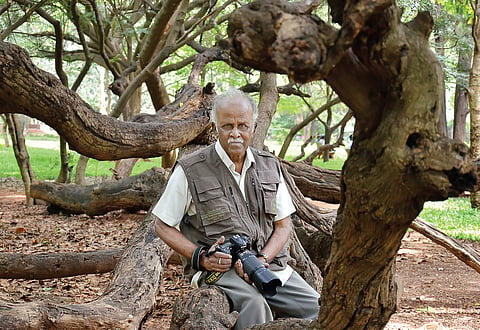

Much before he turned into a wildlife photographer and conservationist, Thanjavur Nateshachary Ayyam Perumal (TNA Perumal) would enjoy an occasional bout of shikar in the jungle. However, when the desire to do good through photography and conservation took over, his work began to speak for itself and his iconic black-and-white snapshots are applauded to this day. His has been a remarkable life with some 50 years devoted to wildlife photography. The octogenarian, who received a Lifetime Achievement Award for wildlife photography in 2013, is as committed to his work today as he was back then.
Even as a youngster, wildlife beckoned him with Jim Corbett’s exploits and other shikar-related literature being a big influence. The nearby Banerghatta forest (on Bangalore outskirts) exerted a magical pull to which the young lad succumbed gladly, having seen a leopard there for the first time.
Later, Perumal and other wildlife enthusiasts started a wildlife society, today known as the Karnataka State Wildlife Association. Photography entered the picture only later, thanks to O C Edwards, his schoolmaster and a pioneer bird photographer. “Wanting to photograph owls, Edwards came to Banerghatta and I ended up as his field assistant,” says Perumal. “A strong bond developed between the two of us, sparking my interest in photography. When convinced of the seriousness of my interest, Edwards gave me a camera with the money for it to be paid in instalments,” he adds.
Perumal immersed himself in the art, but did not harbour a fondness for any particular camera. Right now, the Nikon D70, D80, D200 and D300S vie for his attention, a far cry from when his work was accomplished with borrowed equipment. Similarly, he did not have a muse. “I am not a specialist, our country’s biodiversity provided enough scope to photograph so many things. For me, the challenge was to photograph small insects.”
Naturally, the ace photographer got to rub shoulders with some of the greats in wildlife photography, many of them his contemporaries like the great naturalist M Krishnan, Maharaja of Korea (a small principality in present day Chhattisgarh) BNS Deo, F W Champion, Salim Ali and Maharaja of Sandur, M Y Ghorpade. Of the latter, he says, “We had a great bonding, over 42 years of friendship.”
“Back then,” he says, “it was difficult to own a camera, much less get film for it as it was rationed. But guns, one got easily,” he laughs. “Photography was taxed. The voice of humans used to have animals scurrying, unlike now. Forty years of roaming in Bandipur and I was not able to shoot a single tiger picture. Five years back I got lucky.”
Perumal has witnessed great changes in his profession over the years. From a distinctly black-and-white world to one awash in colour to the advances in technology. “In those days, shooting a tiger earned a one-sovereign reward. There was no telephoto lens too, so if we wanted a close-up shot of say a bird, we had to move the camera close to the nest, about two feet, with a close-up lens covering the normal lens. The camera itself would be remote controlled with some special mechanics with the photographer hiding at a distance,” he says.
The soft-spoken lensman has some strong views on the relationship between wildlife photographers and the government. “The government has not given wildlife photographers their due. Photography is a major tool of conservation and more challenging than hunting,” he says. “Tribals should also be involved in conservation. After all, they know the forest better than any of us.”
