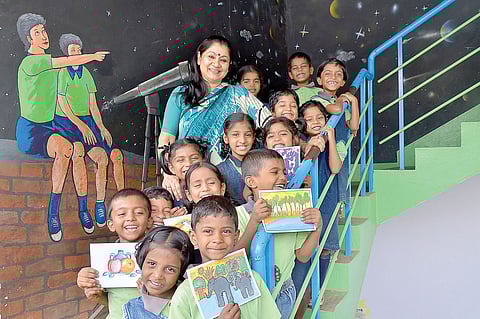

Now in its thirteenth year of helping underprivileged children realise their potential, the Parikrama Humanity Foundation in Bangalore has come a full circle. Their Heart for Art three-day exhibition, held last week, showcased drawings and paintings by these very children, says founder Shukla Bose, and is the culmination of a process that has lasted all these years.
What is now a group of four schools across Bangalore had very humble beginnings, much like its students who come from slums, orphanages and shelters for children of convicts. “My kitchen table was my office and slum children from Koramangala were my first students,” reminiscences Shukla.
As an MBA graduate who worked in the corporate world, Shukla felt in 2000 that her job lacked meaning. “I’m not saying that what corporates do is not useful, but it sometimes lacks meaning,” she says.
Since the Foundation was instituted as a not-for-profit company in 2003, Shukla has tried to bring to the table, the best of what she learnt at her previous job and during the seven years when she volunteered with Mother Teresa’s charity as a schoolgirl in Darjeeling.
It is because of this deep thought that has gone into its creation that Parikrama provides children with more than just a classroom environment. It strives to create an atmosphere that makes learning engaging and interesting. Though the CBSE syllabus is followed in the schools, the curriculum is not limited to it.
As one walks around the Jayanagar campus, it’s hard to miss the bright, colourful walls painted and decorated by the students in mature strokes.
“Finally India is sending its children to school. But it’s also important to look at what happens at school. It’s not enough if the child becomes a statistic and the focus is on how much he/she scores in board and competitive exams. Numbers are important, especially for our children. But they are also vibrant human beings, and we want all their talents to blossom,” she elaborates.
So at Parikrama schools, sports and cultural activities are encouraged and the children are trained in basic computer skills from class one.
“What’s more we’ve busted all the common myths about children from underprivileged backgrounds. That their drop-out rates and absenteeism is high, that they don’t go to college,” Shukla says fiercely.
She adds that at Parikrama, 98 per cent finish school and go on to complete a university education and that attendance and drop-out rates stand at 96 and 1 per cent, respectively. “This is what makes one wonder what the HRD Ministry is doing,” she adds as an afterthought.
But when it comes to art, it’s more than a skill that’s being nurtured. It’s also cathartic, since the students, and several of them, come from abusive family backgrounds.
“We have psychologists at all our schools, and they regularly assess what students depict through art,” says Shukla.
And these past traumas make the love in the equation all the more important for her. Children need to be loved and taught how to love and empathize in return. While they seem carefree at school, talking of their aspirations with confidence—to become a writer, an engineer, a chef—they are quick to run into Shukla Akka’s warm embrace.
“These children are like our own,” says Shukla. “They are in school with us from KG to class 12. But after school would you tell your child, I’ve looked after you so far, now you are grown up and you have to fend for yourself? That’s not how it works in India,” she adds.
So through its Final Leap Programme, Parikrama pays the college fees of its students who finish schooling.
“So we have one old student who is a software engineer at Cisco, one’s the head chef at Hilton International,” Shukla shares proudly.