
In early 2010, Bangalore-based artist M Santhamani embarked on a boat journey down the Ganges, along with two other women friends. She wanted to understand better the relation between nature and human beings. The trio began at Allahabad and, for the next three months, they travelled steadily, till they reached the Farakka Barrage in West Bengal, 800 kms away. On the way they keenly observed the life on the banks. And it was then that Santhamani had an epiphany.
“Everything that we do on the banks of the Ganga is being enacted in our lives,” she says. “The journey gave an understanding of how people live and cope with the river, not only economically and physically, but mentally. Then I realised that the Ganga is a backbone of the country. So many rivers, like the Indus and Brahmaputra, are the backbone of civilisations. Somewhere along, the concept of the backbone came up.”
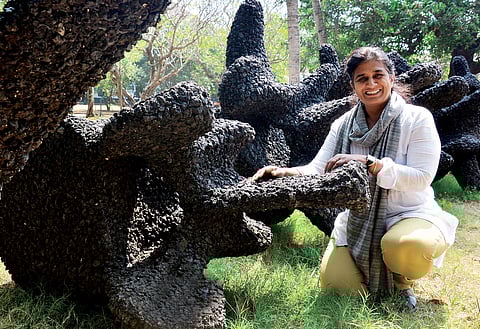
So when she was invited to provide an art work for the Kochi Muziris Biennale, Santhamani decided to make a backbone. At her studio in Bengaluru, she used cinder and cement. Cinder is the waste material after coal is burnt. “It is hard and robust,” she says.
The end result, her work ‘Backbone’, consists of 23 pieces. Each is shaped like a vertebrae, and has been placed on the ground, at the Aspinwall House, one after another, in the form of the spinal cord, with a length of 73 feet. “The actual spinal cord has 33 links,” says Santhamani. “But I did not want a too-obvious reference to the human backbone.”
In fact, when you look at the sculpture, you get a feeling of a flow, like that of the river, near the site. “I wanted to give a hint of the impact of water on Kerala’s multiple cultures,” she says.
It is one of the more striking works at the Biennale. Many people come up and touch it. Some caress it. A few lean on it. A happy Santhamani says, “As an artist, I don’t want art to be only viewed. I want it to be part of your tactile experience.”
Throughout her career, Santhamani has opted for unusual materials for her art, but her preoccupations have been charcoal and paper. “They come from different processes,” she says. “Wood is burnt to become charcoal, while the pulp of wood is grinded to make paper. Both are fragmented and fragile. So I felt that the material lends itself to talk about issues like global warming, which is leaving the planet in a fragile state.”
Her attraction to paper occurred when, in 1991, following her MA in painting from The Maharaja Sayajirao University of Baroda, she went to Glasgow and worked with Jacki Perry, one of the foremost artist papermakers in Europe. When she returned, she began sculpting things with paper.
“I wanted to use delicate materials and talk about strengths,” she says. Santhamani placed photos, textiles, fibre and charcoal into the paper installations, which were at a height of eight and 10 feet. “I tried to push the scope of paper,” she says. “The Japanese can build a house with paper. We have no idea of how strong paper can be.”
Her work has been displayed at Miami, Paris, London, Tel Aviv and Singapore. “The West embraces experimentation quickly. They give importance to what is new and want to look at the possibilities of whether they can take it further. We are slow in this aspect.”
But the awareness of art is speeding up. At Fort Kochi, when she tells a tea-seller that she is an artist, he says, “Last year I could not make it to the Bienalle, but this year I want to make sure I see all the art works.”
The Journey
● Shantamani is supported by the Susan Tarasieve Gallery in Paris.
● She works from 9.30 am till 7 pm at her 4,000 sq ft studio in Bannerghata
● The 23 pieces of her work ‘Backbone’ were loaded onto a truck with the help of a crane and brought to Kochi
● She studied art in Mysore