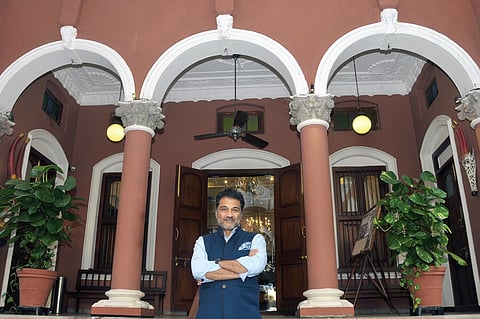

Abhay Mangaldas is a hotelier with a difference. He has restored and renovated his ancestral house in Ahmedabad into a heritage hotel called House of Mangaldas Girdhardas and has built a heritage tourism ecosystem that includes walking tours from the property to sites in the six-century-old walled city. He has acquired two havelis in the old quarters of the walled city and has opened them for tourists. Following in the footsteps of his grandfather Mangaldas Girdhardas, who was a textile industrialist, Abhay is also making a gallery that will showcase the traditional and modern textile heritage of Gujarat.
“The term heritage hotel evokes visions of a palace or a traditional haveli owned and run by descendants of an erstwhile ruler, usually redone for tourists. When I decided to convert the house built by my grandfather in 1924, I did every aspect of the interiors subtly to look and feel like the 20th century house of an affluent Gujarati family with tapestries, furniture and indigenous crafts. We have added modern conveniences required by metropolitan tourists, but these do not intrude on the overall ambience. That is a differentiating factor between us and most other heritage hotels,’’ says 50-year-old Abhay.
Set amid medieval mosques and ornate Gujarati houses, the sprawling hotel has an Indo-European façade and a pleasantly green courtyard. A portico marks the entrance to the lobby that has a Vaishnav temple near the door, common in most Gujarati homes.
“Typically in Gujarati homes, you’ll find a swing called jhoola or ichka, which is like a bed or settee. We have swings and teakwood furniture, just like in affluent Gujarati houses,” he says. “While most people talk about luxury as something imported from western countries, we have tried to be indigenous. Most
of the tiles and sanitary ware has been sourced from within the state.”
The restaurants serve food cooked with fresh regional produce and is served in thalis made at metalcraft centres in Gujarat. Each room is themed on a different Gujarati craft like appliqué, embroidery or tie-dye, used for the linen and as decorative wall pieces. “Family photographs and ancestral portraits of my family members span walls in the property,” says Abhay, who has studied computer graphics in Boston.
His ancestors built the complex that is now the 36-room hotel, between 1904 and 1907. In 1924, Mangaldas Girdhardas built his house, while his elder brother Chimanlal Girdharlal continued to live in the older one, the C G Wing. As the old city became too noisy and chaotic in the 1930s, the family began to move to newer areas. The migration was complete by the ’50s. In the ’60s, a department store was started in the premises and later a denim shop, but otherwise the property was neglected. Once the shops closed down in the 1980s, it began to fall into ruin and some parts were rented out to offices.
“The challenge I faced was getting the tenants, some of them government offices, to move out so we could renovate the property. In the meantime, I started two restaurants. Agashiye on the rooftop is a Gujarati cuisine specialty restaurant, while Green House in the courtyard is a coffee shop. The Italian mosaic and marble flooring, stained-glass windows and Baroque decorations were restored, and the restaurants were opened in 1999,’’ says Abhay. The hotel was opened in phases from 2004. In 2007, work started on the C G Wing and was added to the heritage hotel in 2014.
Of the two havelis he has recently acquired, one will be a craft shop and café, and the other will be a six-room boutique. All the properties will be connected to each other by shuttles so that a tourist can stay at one, visit another for a meal, spend time at a third and explore history and culture in the walled city.
