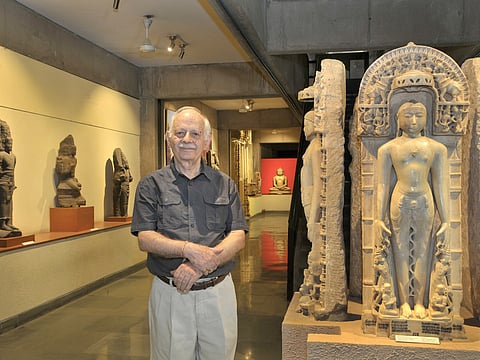

At the Lalbhai Dalpatbhai Museum in Ahmedabad, museum director Ratan Parimoo points to a scroll painted by the Mughal painter Ustad Salivahana in 1610 AD. It depicts Mughal emperor Jahangir’s farman (diktat) prohibiting the killing of animals in his empire during the Jain festival of Paryushana. This painting has generated much interest after the recent meat ban during the festival.
“This painted farman called Vijnaptipatra is one of the many paintings at the museum, which has one of India’s finest collections of Jain art, including sculptures, scrolls, illustrated manuscripts, book covers and miniature paintings,” says Parimoo, an art historian and former professor. “We also have fine Buddhist, Hindu and other arts,” he says.
The museum has recently been reorganised with financial assistance from the Central government. The work was completed this year. It now has sections on Jain paintings, sculptures, miniature paintings, coins and Buddhist artefacts, making it easy for visitors to locate areas of their interest.
“The visitor experience has been enhanced by the reorganisation into departments,” says Parimoo, who was surprised to see a low visitor turnout when he joined the museum in 1997. With its outstanding collection of historic Indian art, including rare Jain works, the Lalbhai Dalpatbhai Museum is fast becoming a key site on the tourism circuit of Ahmedabad. Earlier, it was visited only by scholars. But now tourist groups and schoolchildren are regular visitors to the museum.
Parimoo says the museum is part of the Lalbhai Dalpathbhai Institute of Indology that was opened in 1956. The collections of Jain scholar Muni Punyavijayaj and Jain industrialist Sheth Kasturbhai Lalbhai, one of the post-Independence institution builders of Ahmedabad, are housed here.
“The museum was opened to the public as the Lalbhai Dalpatbhai Museum in 1984 with two galleries, the Smt Madhuri Desai Gallery on the ground floor—exhibiting a stunning collection of sculptures and woodwork—and the Muni Punyavijayaj Gallery with its Jain art on the first floor,” he says.
In 1993, the museum was enriched by the collections of N C Mehta Museum of Miniature Paintings. “Later, Priyanka Munshaw’s coin collection, Lilavati Lalbhai’s woodcarvings and bronze Buddhas and Arvindbhai Narrottam’s Chola bronzes were added,” he says.
The key collection of the museum is Jain art. While miniatures of the Mughal School have become famous, not much has been written or talked about the Jain miniature paintings.
“A special style of painting was evolved for illustrating Jain manuscripts that were written on palm leaves and later paper sheets that were rectangular and horizontal in orientation and narrow in width,” says Parimoo. The height of the space given to artists was just three to four inches. The paintings depicted the Kalpasutra and Kalkacharya Katha, tales from the lives of Jain Tirthankars.
“The Jain style of Gujarat, part of the Western India Style, predates the Mughals, and Akbar’s court too had painters from this style,” says the museum’s director.
The museum also exhibits some rare Jain bronzes, cloth paintings and stone sculptures. “Our dream is that our outstanding exhibition of the arts becomes well known as a national museum,” says Parimoo.
