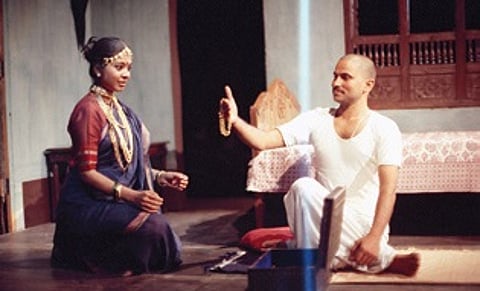


Only a few other plays have captured the swift decline of rural India of the 70s better than Mahesh Elkunchwar’s trilogy, Wada Chirebandi (Old Stone Mansion). I remember watching the premiere production of the first of this trilogy in Mumbai in mid-1980s with Vijaya Mehta (who also directed it) in one of the key roles—Aai, the powerless matriarch around whom four generations of the Deshpande family disintegrate. It was a turning point for Marathi theatre, and Elkunchwar finally replaced Vijay Tendulkar as the reigning king.
And now 35 years later, there is an in-depth analysis of this play, and of the entire development of Marathi theatre in the 20th century, in a three-volume opus, A Socio-Political History of Marathi Theatre by Makarand Sathe, recently published in English.
I remember that in Vijaya’s production, Aai, the long suffering wife of a Brahmin family, sat on the centre-stage through the two-hour play as the story of her four children and their ancestral homestead unfolded. Bhasker, who has stayed on in the village and not done too well, is married to a traditional wife.
His younger brother, Sudhir, has moved to Bombay and is married to the Anjali. The third child, a daughter, Prabha, yearns for an independence she can never attain. Finally, there is Chandu—ignored constantly, physically injured, and is always at the receiving end.
While the first play brings the siblings together after their father’s death, the second one opens with the outsiders from Mumbai, returning for their nephew Parag’s wedding. A sour and immoral young man, resentful of never having been taken to Mumbai by his uncle Sudhir, Parag is rebellious and arrogant.
Abhay, his cousin, has migrated to America and though he achieves material success, feels empty and disillusioned by the end of the trilogy. Ranju, Parag’s sister, longs for the glamour of the Bombay film world, there is a yawning gap between the life she lives and the one she aspires to. She finally runs away but is brought back to the village. Parag’s wife, strong-willed Nandini, emerges as the contemporary Indian woman willing even to accept her husband’s affair with a widow, and gradually becomes the fulcrum of the family.
By the last part of the trilogy, there are only four characters left. The last play begins with Abhay’s return from Sweden on the occasion of the death of Aai, Parag and Abhay’s grandmother. The village has now turned into a barren desert. It is nearly non-existent.
Parag has gone to Kashi, as the village doesn’t even have water for the last rites. When he returns, he brings back Chandu. But why? Parag says: “The house belongs to him too.”
Even in such dire circumstances, human values still prevail. The rest is a desert. What does this desert and this desolation symbolise? In Elkunchwar’s words, “This play is about the inner space of these four characters. At one level, it is about the devastation unleashed by us and of the resultant barren desert—a desert of the spiritual, political, social, environmental, and all other kinds.” Elkunchwar takes us on a captivating journey, highlighting the minute aspects of traditional culture. The play is a classic example of the use of the realistic form. Many metaphors are used. For example, the ‘Wada’ itself. The wealth and corruption of jewellery, the immobile, rusting tractor, pond, and finally the all-enveloping desert. Elkunchwar writes, “A pond fascinates me. It means stillness for me. No turbulence, no ambition to go anywhere, a kind of self containedness.”
Powerful images of a changing rural India, ‘Wada’ is the most important set of plays written in the last 50 years and Sathe’s book eloquently explores this.
—feisal.alkazi@rediffmail.com