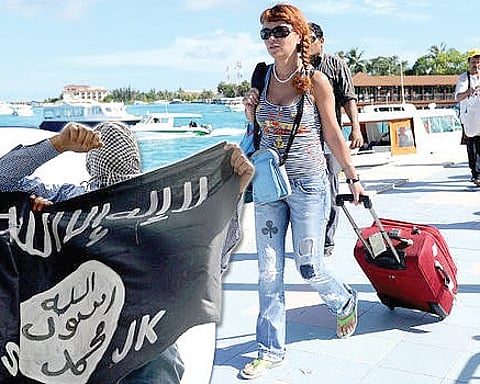

For the million tourists who fly in each year to the Indian Ocean archipelago of the Maldives, the holiday paradise of idyllic white sand beaches, warm blue waters and waterfront villas quickly embraces them.
But their isolated luxury resorts are a world away from the country’s increasingly conservative Islamic society. From the impossibly crowded capital of Male to remote fishing villages, the siren call of radical clerics is luring locals towards a very different paradise.
More than 200 island jihadists are now believed to be fighting in Iraq and Syria, and at least seven have died for the cause. For a nation that only has a population of about 350,000, the numbers are strikingly high. “It’s quite probable that, in per capita terms, the Maldives has more jihadists fighting in Syria and Iraq than any other country outside the region,” said a Western security analyst.
There has been a surge of Maldivians travelling to Syria in recent months, often husbands and wives with their children. They are leaving behind a very different country from the tourist brochure image. In Male, a ban on alcohol is strictly enforced. Most women have started wearing headscarves and even full black robes, whereas many men have grown out beards.
The Maldives’ international image had already taken a blow in recent years due to prolonged political unrest, culminating in the jailing this year of Mohamed Nasheed, the country’s first democratically elected president.
Nasheed, who in recent days has been defended in court by human rights lawyer Amal Clooney, was overthrown in a bloodless de facto coup during protests organised by supporters of the former dictatorship and religious groups under the banner of “Defend Islam”, as hardline clerics accused him of trying to pollute the country with decadent liberal values.
The surge in radicalism in recent years has its roots in several factors. Some politicians have encouraged Islamic hardliners for domestic political benefit, an increasing number of young Maldivians have been sent to study in madrasahs in Pakistan and Saudi Arabia, and an influx of Saudi money has funded Wahhabist groups.
There was already a long, if less-publicised, history of Maldivian fighters joining radical Islamic causes, with many receiving weapons and explosives while training with al-Qaeda dating back to the Nineties.
A senior former Maldivian counter-terrorism official told The Telegraph that returnees from those conflicts walked openly on the streets of Male. “We know who these guys are, but there is not the evidence or the organisation for the state to pick them up,” he said.
The latest concerns surround the danger to tourists—especially in the wake of the deadly attack in Tunisia. “Our assessment previously was that local radical groups would not strike on their home turf, not least as they did not want to attract the sort of attention that would come with it,” said the former official. “But with the emergence of groups such as ISIS, that assessment is changing.”
For moderate Maldivians, the threat is already real. Moderators of secular Facebook groups and an openly gay blogger have been attacked, threatened and forced into exile. Journalists critical of state and faith “disappear”. The government has downplayed the dangers posed by Islamic fundamentalism. But it only takes a quick trawl of YouTube to find jihadist videos in the local Dhivehi language.
