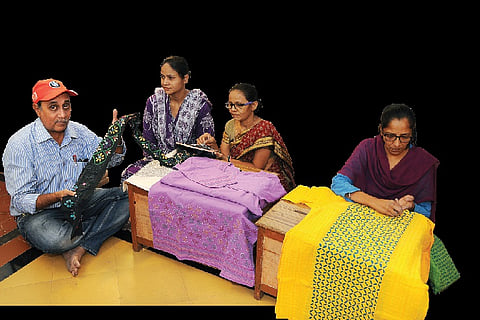

It is a kaleidoscopic treat for history buffs. Heritage walks at Dhal ni Pol, one of the oldest areas of Ahmedabad as well as one of the largest residential clusters of its walled city, are showcasing the artistic heritage of Gujarat’s capital from woodcarvings, stuccowork and glass decorations of the historical buildings to its vibrant living traditions: embroidery, block printing, tie-dye and other handiwork by craftswomen.
The popular Crafts Heritage Walk and the Ashawal Walk, launched in September 2015, are a joint initiative of French Haveli, SEWA Foundation and Mahila Housing Trust. These seek to rejuvenate the pol (a housing cluster comprising families of a particular group, linked by caste or profession) by bringing its heritage into focus and promoting its handicrafts, food products and home stays.
The walks are curated by Ashish Mehta, photographer and heritage activist, with the help of architect and heritage activist Debashish Nayak. The walks can be booked through the heritage hotel French Haveli in Khadia or the Sewa Co-operative Federation’s recently renovated handicraft centre at Sewa ni Haveli.
Sewa ni Haveli, a restored and renovated mansion owned by Self Employed Women’s Association (SEWA) in Dhal ni Pol, was opened in 2014 with workshops to facilitate about 500 women artisans of Ahmedabad and to retail their works. “This historic three-storey haveli is the starting point for Crafts Heritage Walk of Ahmedabad and the climax of the Ashawal Walk,” says Mehta, who runs a group called Meet Me in Khadia to promote the built and living heritage of Khadia, Ahmedabad’s oldest district.
Besides its living traditions, Dhal ni Pol’s rich history is another major draw for tourists. “Dhal ni Pol literally means the sloping neighbourhood. It slopes down from a hillock that was the headquarters of Bhil king, Asha, who ruled over the city called Ashawal after him,” says Mehta. “This city was taken over by Raja Karna Solanki and became known as Karnavati. When Sultan Ahmed Shah founded the walled city of Ahmedabad in 1411, the residential clusters called pols were created over the centuries. Dhal ni Pol is second only to Mandvi ni Pol in size, and has five entrances,” he adds.
Since many affluent textile industrialists lived in this neighbourhood during the 1800s, it has some fine havelis with woodcarvings and stuccowork. In recent years, Dhal ni Pol has become a focal point of heritage activities. Besides the French Haveli, several old havelis here have been turned into home stays. Then there is the Sewa ni Haveli crafts centre and design resource for artisans, and the Mahila Housing SEWA Trust (MHST) that is working to build housing facilities for underprivileged working women from the informal sector in such neighbourhoods.
“Together, the organisations have created walking tours and events to bring the rich heritage of Dhal ni Pol into limelight. Lalita Krishnaswami, chairperson, Sewa Cooperative Federation, Rajiv Patel of French Haveli and the team at the MHST are the people behind the Dhal ni Pol walks,” says Mehta.
The Craft Heritage Walk was initiated by the City Heritage Centre, an institute developing human resources for heritage management. The walk has been designed by Nayak, who pioneered the successful Ahmedabad Heritage Walk in the 1990s. On the walk, tourists can watch artisans busy at embroidery, tie-dye, block printing and other handiwork. Next stop on the walk is the French Haveli, decorated with murals and handicrafts of Gujarat. Near the haveli are the richly ornamented stone or wooden bird feeding structures called chabutras. Further ahead are Jain temples with their gorgeous historical glass paintings. The walk ends in the market square around the historic mausoleums of the Sultans and Ranis, the centre for silver crafts.
“The second walk in this area, the Ashawal Walk was curated by Nayak and me to cover the history, architecture and crafts of the pol. It covers temples, including those from the time of the Bhil king, and dargahs, havelis and places associated with folk tales,” says Mehta. The walk ends at the Sewa ni Haveli for crafts demonstrations.