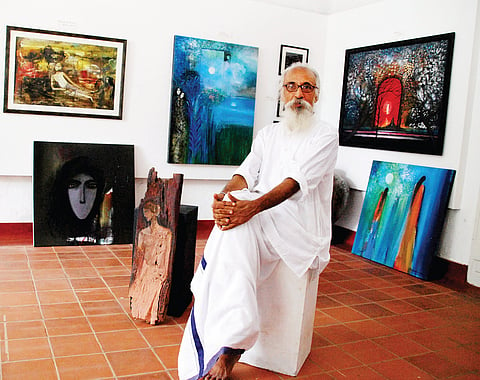

When artist Paris Mohankumar visited a house in a tribal area at Wayanad in north Kerala, he saw a girl with a broken leg lying in bed, her bone jutting out. When he asked why she had not been taken to a hospital, he was told that the family had no money. In another house, he saw a wooden piece that was part of an old door. It had scratches and a couple of holes. Mohankumar took it home, and painted the figure of a woman on it, in a pastel shade, with the face turned sideways, her hair held up in a bob. It was titled ‘Rebirth’.
The piece is on display at Reverberations: The Unheard Whispers exhibition by Mohankumar at the David Hall gallery, Fort Kochi. The exhibition is open till June 15. “I want to sell ‘Rebirth’ and use the money to provide treatment for the girl,” the 70-year-old artist says. “Then she will experience a rebirth.”
The exhibition displays 100 paintings in acrylic, oils and watercolours. It comprises his work of the past 10 years.
The recurring themes in almost all the paintings are women and environmental degradation. In the painting ‘Gingee Fort’, Mohankumar has placed a woman against the backdrop of the Parthenon in Greece, Gingee Fort in Tamil Nadu, the Sacred Heart Basilica in Paris, and the Colosseum in Rome. In the foreground is a large tree with several bare branches, which go right across the canvas.
In many other paintings, he has shown wilting grass, leaves and trees. “In Wayanad, where I live, factories are coming up and spoiling the landscape,” he says. “Most of the politicians are only interested in making profits.”
Another endangered area is the Nilgiri Biosphere Reserve. “I am told that more than 5,000 acres is up for sale,” says Mohankumar. “I am trying to highlight all this through my work.”
As for the presence of women in all the works, Mohankumar simply says, “I worship them.” There is a reason for this. His father Kunjiraman, a Communist leader, was killed at the French enclave of Mahe in Kerala when Mohankumar was only two years old. The artist was brought up by his mother and grandmother. “My mother avoided re-marriage so that she could bring me up, even though she was beautiful and had many suitors,” he says.
The gifted Mohankumar made a mark when he was a teenager through his paintings and sculptures. When a well-known monk, Swami Dayananda Saraswati, asked him to do a sculpture of a Hindu god, Mohankumar was at a loss; because of his father’s Communist leanings, there was no religion in the house. He consulted an encylopaedia which belonged to his father and did a bust of Socrates. When he displayed it to the monk, his followers were flummoxed. “Everybody asked the guru, who is this?” says Mohankumar. “Swamiji replied that this is a ‘god of gods’.”
Impressed, Saraswati invited Mohankumar to his ashram, which was just eight km from his house in Mahe. Mohankumar learnt meditation and yoga at the ashram, after which he spent five years as a member of the Aghoris cult in Rishikesh. But all along, he was obsessed with art. And with the swami’s help, he went to Paris in 1974, and started a career as an artist.
“My work has been shown in 40 countries,” says Mohankumar, who spent two decades in Europe. His high point was when he was honoured by UNESCO in 1988 as one of the 40 greatest artists in the world. Today, he is on a mission to encourage organic farming among the tribals in Wayanad.
“Mankind should realise it cannot survive, unless we nurture the environment,” says Mohankumar.
At David Hall gallery, Fort Kochi; on till June 15
