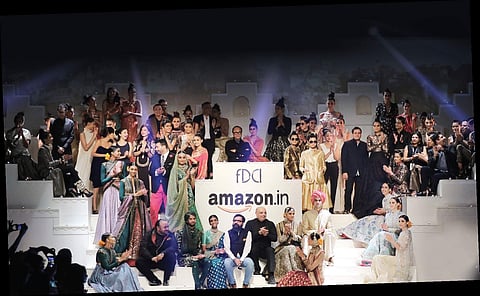

Come October 12 and silks from Chanderi will take over the runway at the 28th edition of India Fashion Week. Sixteen designers—Aneeth Arora, Anita Dongre, Atsu Sekhose, Gaurav Jai Gupta, Samant Chauhan, Ragini Ahuja of Ikai, Payal Pratap and Ruchika Sachdev of Bodice, among others—will put the indigenous handlooms on the world map as they open the spring-summer 2017 edition. This isn’t the first time that handloom has been a frontrunner at Amazon India Fashion Week. Last year, designers came together to craft a dream grand finalé, weaved in Benaras brocade, called Born in Benaras. Sanjay Garg of Raw Mango opened the show with his line of saris handmade with mashru, a blend of silk and cotton fabrics from Patan and Mandvi in Gujarat.

“We have been a part of the revival movement of the handloom sector. After khadi and Benaras weaves, we’re trying to strengthen the Chanderi belt of central India,” says Sunil Sethi, president of the Fashion Design Council of India (FDCI) that organises fashion weeks in Delhi.
Away from the catwalk parades and the limelight of fashion shows, Mani Aiyya, a fourth-generation weaver, sits behind his loom in his tiny house in Weavers Colony, a dusty hamlet in Narayanavanam mandal in Chittoor district of Andhra Pradesh. He looks up at intervals and stretches his back, briefly impeding the rhythmic clacking of his loom.
He may be weaving in a remote part of India, but Mani nods when we speak of National Handloom Day. “I couldn’t afford to travel to Chennai to be a part of the celebrations,” says the 55-year-old. He tells us how this village of 7,000 weavers now has only 500 people weaving. Mani, who used to export cotton shirts to countries like the US in the 90s, is forced to weave towels and lungis.
But he has not given up. In a hope to pass on the tradition, he has set up 30 mini looms to train youngsters and often visits schools in and around Chennai to educate children about handloom. For him, till the time weaving pays him to eat two square meals a day, he is happy. What makes him happier though is how handloom has become the toast of the town in last 18 months.
It all began with Prime Minister Narendra Modi declaring August 7 as Handloom Day in 2015. A fervent passion swept the nation. Students of IIT Hyderabad sported ikat capes for their graduation ceremony and women draped pre-stitched nauvaris at the annual Bay Area Costume Marathon in California this May. But handloom isn’t new to India. It has been a strong component of our heritage in every sense of the word.
According to the 2009-2010 Census, handloom weaving has emerged as one of the largest economic activities after agriculture. With nearly 43 lakh weavers and allied workers, the sector forms an integral part of the Indian social fabric. “The British almost botched up our weaving tradition as they could not handle its growing popularity in Europe. They first banned export of brocade silks from Benaras and introduced power looms. Cheaper versions were exported then, pushing the weavers’ community to give up,” says designer Ritu Kumar. Kumar, who has been working with the weavers of Uttar Pradesh for over two decades and has seen the decline.
Kalamkari (chintz) met a similar fate when it got the Dutch jealous and vengeful. In the 90s came the Chinese faux silk that took over the market. But somehow Indian craft has always managed to rise from its own ashes like a phoenix. “Indian textile tradition is intrinsically flexible. It adapts to changing times and need,” says David Abraham of Abraham & Thakore, a Delhi-based label that made handloom textile fashionable. David Abraham and Rakesh Thakore have long been a champion of handloom weaving. They have made dresses out of khadi and cotton, used embroidery as surface texturing on long tunics and created silk saris with double ikat prints. Their creation from Sari Silhouette line (2011)—a belted, charcoal silk sari with a silver border and cycle rickshaw motif—is displayed at the Victoria and Albert Museum in London as a part of its permanent collection.
The designers are optimistic about handloom future. “A clutch of designers are engaged in bringing the focus back on the traditional fabrics and are also opening new markets,” Abraham adds.
“It’s not difficult to work with handspun or handloom fabrics. All one needs to understand is its character. Our kaarigars know fabrics like the back of their hand,” says Delhi-based designer Anju Modi, who adds a twist to make age-old crafts fit for the modern silhouette. “After cutting and stitching became integral to silhouette, we had to contemporise the fabric,” she says. Weavers she works with use thicker or blended yarn, strengthen the weft and increase the thread count. Even after working with hand-woven textiles for 25 years, The designer considers artisans her guru and believes that they need to be encouraged and supported.
Designers are thinking out of the box, questioning the use of fabrics. “For my collections, design is kept bare minimum, void of pattern. I play with textures of the fabric, highlighting the taana baana. Fabrics become the design,” says Ruchika Sachdeva of Bodice.
Designer Aneeth Arora experiments with a range of handspun fabrics and hand-embroidery. Her label Péro is known for its modern take on textiles. She has a penchant of using a local craft in an innovative way, be it Bengali woven checks or colourful kutchi fabrics. For her fall-winter 2015 line, she used hand-woven wool from the Himalayas and indigo resist block-printed khadi from Gujarat. “It is only in India that a designer can walk up to a weaver and get a 50-metre fabric hand-woven with his or her designs on it. Everywhere in the world the connect between the designer and manufacturer is lost,” Abraham adds.
Jaya Jaitly, president of Dastkari Haat Samiti, says, “Weavers are the propagators of our heritage that has died all over the world. The idea behind revival of handlooms is to preserve Indian identity as well as weavers’ livelihoods.”
The Indian weaver community, happy with the newfound attention, is doing its bit. Patnam Cheerala Reddy, a 61-year-old weaver from Nellore in Venkatagiri, Andhra Pradesh travelled to Varanasi on Handloom Day this year. He received an award from Union Minister for Textiles Smriti Irani for a cotton sari he and his sons created. “It took us three months to weave Maha Vishnu Sesha Sai, a sari with the image of Lord Vishnu,” says the National Award winner. He owes a lot of his success to mentor Gowrabathina Ramanaiah. Four years shy of 70, Ramanaiah is a veteran weaver who has trained and supported many like Reddy. While he finds it encouraging that designers want to work with handloom weavers, Ramanaiah stresses that they must understand the technicalities before experimenting. “Designer Manish Malhotra, who orders fabrics from us, knows how to work with fabrics,” he says.
Ramanaiah works with over 45 weavers to make saris and wall-hangings under the India Handloom Brand (IHB) launched by the Prime Minister as a part of National Handloom Day celebrations. “We send samples to the Weavers Service Centre and receive a brand certificate valid for three years,” says Ramanaiah. There are rigorous quality checks and parameters that weavers must adhere to get the IHB label.
C Sekar, president of Anakaputhur Weaver’s Association in Tamil Nadu and a weaver himself, is trying to get design students from NIFT, Chennai, to learn and work with his community. “Design development needs to go hand in hand with the handloom industry,” the 52-year-old says.
“The mood among the weavers’ community is of general euphoria,” says Ally Mathan, co-founder of the online movement, 100 Saree Pact and the Registry of Sarees. She believes that the recognition is long overdue. Mathan and her Bengaluru-based team offers a platform for enthusiasts to learn about Indian textiles and interact with weavers and experts and runs weaver support programmes.
Surat-based company Triveni works towards breaking stereotypes looming over ethnic wear, especially saris. It runs Dare2Drape challenge where women are invited to try different saris every week and post it on social media. They are featured on their website triveniethnics.com along with the description of the sari, its weave, origin and drape style. “We send one complimentary sari to each woman who participates in the challenge,” says Arvind Saraf, who heads the company.
Mathan thinks that Textile Minister Irani’s #IWearHandloom campaign was a stroke of genius. According to the minister’s office, it made over 51 lakh impressions with more than 58,000 interactions on Facebook in less than 24 hours. On Twitter, the campaign’s reach has been 1.55 crore with 2.17 crore impressions of the hashtag. FDCI president Sethi also supported handloom by posting pictures. “FDCI is not only showcasing handloom in its modern avatar but also touching lives of weavers at the grassroots level,” he says. Sethi believes it’s just the beginning.
“Efforts like these also need to be sustainable. After awareness, we need to find ways to impart skill development and upgrade technology in handloom sector,” says Hemang Agarwal, a designer from Varanasi, who brought the grandiose of the Benares weaves to Lakmé Fashion Week Winter-Festive 2016 show in Mumbai. Agarwal, who works with master weaver Haji Sharfuddin Ansari of Varanasi, believes that the Benarasi handloom is so versatile that it can be tweaked to suit any design. “Except a few weavers who are not comfortable with weaving human or animal figures, most are are open to accommodating all kinds of design requirements,” the 36-year-old says. “It’s important for designers to help the kaarigar community to move up the economic ladder because we belong together,” Abraham adds.
Delhi-based designer Sunita Shanker, who launched her eponymous label in 1995, extensively uses hand-woven fabrics. She says it’s important to educate people. “With the ‘selfie movement’ there is an instant gratification, but how many of them actually know about the difficulties and work involved in creating a handloom product?” Shanker asks. Designers cannot set unrealistic deadlines while working with handloom weavers and impose them to take shortcuts to deliver on time. “We designers need to be patient, learn the complexities of the fabric and work at their pace,” Shanker says. While weavers gain access to new markets, designers need to retain the salient characteristics of traditional craft practices. “Over the years, there have been initiatives by the government,at sporadic intervals, to revive the handloom segment. But nothing has struck a chord,” says Sabita Radhakrishna, a 73-year-old textile revivalist from Chennai. She has seen the lives of weavers deteriorating over the years.
“The living conditions of weavers of the Kancheepuram and Thanjavur clusters are better than that of Pochampally or Varanasi,” says Radharaman, CEO and design head of the House of Angadi, a Bengaluru based family-run textile business, which has been in the trade for over 600 years. In 1950, the company decided to provide its weavers with housing, medical services, and education for their children. “The wage depends on the labour intensity of the product. Complicated, time-consuming weaving techniques such as a korvai or butta fetch a higher wage,” the 36-year-old says. On an average, a weaver in Kancheepuram earns `15,000-`20,000 per month based on his productivity, which normally translates to three to four pieces a month. For one handloom product, a weaver has to move his hands and legs over 16,000 times.
T N Venkatesh, managing director of the Tamil Nadu Handloom Weavers’ Cooperative Society (Co-optex), is doing his bit. It took him three years and a lot of cajoling to revive seven types of handloom saris. “We’ve been able to restore the lost glory of Koorai Nadu sari, Chettinad cotton sari, Kanchi cotton sari, Kodali Karupur sari and Paramakudi cotton sari,” the 39-year-old says. It was a difficult feat to achieve as most weavers have left the loom for better paying jobs. Co-Optex also revived 21 types of silk saris and motifs through its Vintage Kanjivarams project.
An unstitched handloom product can be identified by the selvedges, or edges on the edges, along the width of the fabric. They are slightly uneven and, in some cases, have small pinholes at regular intervals, where finer cloth has been pinned to the edge of the loom to keep it straight while weaving. Textures are also slightly uneven in handloom when held up to the light. “The IHB tag helps as it has been honestly obtained and certified,” says Jaitly.
Anju believes there’s a market for handloom in every form. “The response I received for traditional weaves and silhouettes that I created for the movie Bajirao Mastani was phenomenal,” she says. She was flooded with requests for similar khadi-muslin dushala, brocade kurta and mashru sharara and saris that Deepika Padukone and Priyanka Chopra wore in the film.
The partnership is not just between the handloom weaver and designer, says Shanker. “What designers are doing is just a tip of the iceberg. The foundation of the handloom industry needs a major shot in the arm. “Until fashion shows also bring some kind of business to fashion designers and in turn to the weavers, handloom revival is difficult,” says Sethi.
Anju also believes that designers have a responsibility towards not only reviving but also reinventing the textile culture. “The idea is to make it practical, travel-worthy, comfortable and affordable for modern wearers,” Modi says.Siddharth Mohan Nair founded DesiTude, a Kerala-based company that makes denim wear made of hand-spun khadi. “In a hot and humid country like ours, a fabric like khadi that breathes and has a better sweat absorption property offers very good comfort in summers,” he says.Both Venkatesh and Radhakrishna believe social media has helped garner a positive response from people, especially youngsters. “Two years ago, I would not have believed that the handloom sector will ever get the buzz back. A spark has been ignited,” says Radhakrishna, who engages with the youth on handloom revival through her Facebook group Kai Thari.Handloom has and will always have followers. It just needs an impactful nudge to bring weavers back to their looms and weaves to their lost glory.