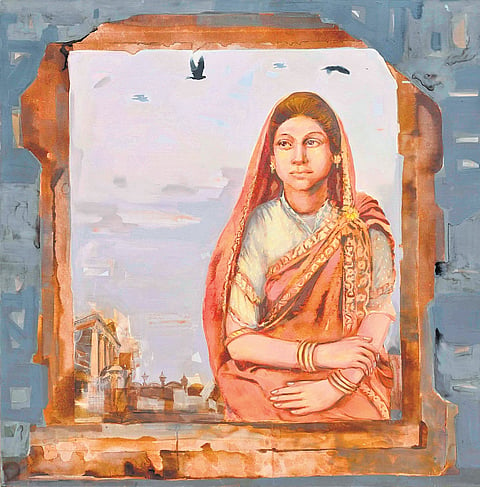

In the art of Dipali Bhattacharya, women hold centerstage. Her works concerns angst-ridden feminine tribulations: their role in familial and domestic spaces, and their fight for social justice and feminism appear in her tour de force Parallel Lives, held at Kalakriti art gallery in Hyderabad. Nostalgia is a common artistic trope: her visual vocabulary is drawn from her personal history and everyday life, such as family photographs, as well as Kolkata’s colonial past. On her canvases women frozen in time creates a mood board of the city of her youth.
“My paintings are evocative of Kolkata, of a certain time and period. It is all gone now, so this is my way of remembering it,” says the 72-year-old artist. The City of Palaces is her muse; her work include Raj-era buildings. After graduating from the University of Calcutta in 1972, she worked as a professor at the Government College of Arts and Crafts for over three decades before retirement.
Even though the colours in the paintings are subdued, giving the impression of viewing the city’s past through a sepia-tinted filter or watching in a looking glass, her pieces brim with life. “Kolkata’s bustling life is reflected in my art. Something is always going on in the city streets as multiple scenes unfold in a single time. These are the colours I see when Kolkata is swathed in at dusk. I’ve have used them to convey the city’s character,” she says. Nature marks its presence on some works with a bright swathe of green, inspired by the Sunderbans.

Bhattacharya created the 40-odd paintings on display over 18 months. Some sculptures celebrate womanhood. She elaborates, “They celebrate women empowerment, sensuous figures of strength and beauty. The scrolls are inspired by Patachitra style.”
Bhattacharya has been documenting Kolkata’s old, crumbling colonial homes for the past two decades. She call son their inhabitants and has persuaded them to let her browse through their family albums and document their stories. Long gone unidentified women from the albums had an impact on the artist which made their way into her canvases.
Curator Anirudh Chari says, “In her work, the personal lives of women whose dreams and desires were not given a voice due to the prevailing social norms are brought to the fore. The exhibition is an echo of her experiences and the women she has met.
She has an uncanny ability of seeing the beauty in mundane things mundane. Moments of stillness she has captured in the busy streets of Kolkata or the hopefulness of women in decrypt mansions are there as well as a celebration of life.” The City of Joy is both her joy and sorrow.