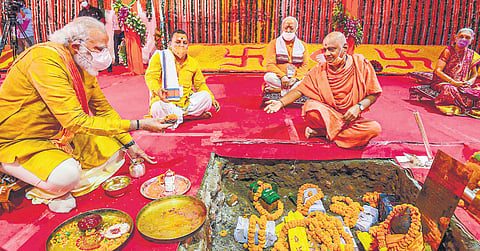

It’s an engineering marvel in the making, meant to last a thousand years. Some parts are ready. The ground floor of the upcoming Ram temple centred on the garbh-griha that will host Ram Lalla after his consecration by Prime Minister Narendra Modi in the presence of 7,000-odd dignitaries on January 22 is all decked up. On Tuesday, the seven-day rituals, led by a team of 121 acharyas of Kashi began with a ‘stand-by’ yajman, Anil Mishra, who is a member of the temple trust. On the final day, the Prime Minister will be the main yajman performing the consecration rituals and opening the eyes of the presiding deity, the shyamal (dusky) five-year-old Ram Lalla sculpted by Karnataka sculptor Arun Jogiraj in shyam shila sourced from Mysuru.
All the rituals are being performed by the vedic acharyas under the supervision of Acharya Ganeshwar Shastri Dravid while Acharya Laxmikant M Dixit, 86, of Kashi would be the principal Acharya. On January 21, Kanchi Kamakoti Mutt Shankaracharya Vijayendra Saraswati Swamigal is expected to participate in the consecration ceremony.
The work on the spire is on, and it is set to be ready before the historic event. “It is the resolve of the workers and managers both to install the spire before consecration to give a befitting reply to those who are claiming that consecration in an incomplete shrine would be inauspicious,” says a construction manager.
The marvel is taking shape in red sandstone and marble over a 2.77-acre plot of land within the 70-acre Ram Janmabhoomi premises. The main structure of the upcoming Ram temple is being built in the Nagar style of architecture quintessential to north India while the other temples in the corner of the complex and the outer wall (parkota) of the temple complex will reflect the semblance to Dravidian style of architecture reiterating the cultural and regional diversity of country’s rich heritage.
“The final structure will not only be an architectural wonder but every bit of it would also be a story of the rich cultural and spiritual oneness of India,” says Girish Sahasbhojanee, the design and construction manager. The upcoming temple is 380 ft from east to west, 250 ft wide while it measures 161 ft in height from plinth to spire. The height of each floor of the temple will be 20 ft with a total of 392 pillars and 44 doors.
The sanctum sanctorum is on the ground floor where Ram Lalla (Lord Ram as a five-year-old child) will rest. On the first floor, Lord Ram, Goddess Sita, and family along with Lord Hanuman will rest. The temple has five mandaps, including Nritya Mandap, Rang Mandap, Sabha Mandap, Prarthana mandap and Kirtan Mandap, all on the ground floor.
The main entry would be from the east. There would be 32 stairs to the main Singh Dwar into the temple. The structure is surrounded by a rectangular parkota (outer wall) which is 732 m in length and 14 ft in width. The four corners of the parkota will have four temples—Sun God, Goddess Bhagwati, Lord Ganesh, and Lord Shiva—all in Dravid architectural style. Moreover, the northern arm of the main structure will have a temple of Goddess Annapurna and the south arm will have one of Lord Hanuman.
Besides, the Ram Janmabhoomi premises will also have seven other temples, dedicated to Maharishi Valmiki, Mahrishi Vashishtha, Maharishi Vishwamitra, Mahrishi Agastya, Shabari, Nishad Raj Guh and sage daughter Ahilya.
An idol of bird king Jatayu has already been installed on Kuber Teela, south-west of the temple. The temple premises would have a green belt with around 1,000 trees of different species.
Around 21 lakh cubic ft stone would be used in the entire structure. Sharing details about the resilience of the upcoming structure, Sahasbhojanee claims that the temple will be very strong. “I have no hesitation in claiming that the complete temple would be an engineering marvel capable of withstanding the vagaries of climate and times for at least 1,000 years,” says the veteran design and construction manager who belongs to Goa and has done his civil engineering from IIT-Bombay. Sahasbhojanee has been in Ayodhya right from the beginning.
“When complete, the structure in its full glory would present a beautiful blend of the architecture of North and South India,” he says. “The granite used in the plinth of the temple has been sourced from Karnataka and Telangana, the stone for superstructure has been brought from Rajasthan, the stone for flooring has been brought from Madhya Pradesh and Rajasthan. Moreover, the 4,000-odd craft men and workers contributing day in and day out have come from every nook and corner of the country.”
Moreover, the iconography on the sand stones is being done by the artists from Odisha, woodwork by the employees of an Andhra firm which has roped in artists from Tamil Nadu. Brassware has been sourced from Moradabad while the gold and teakwood to be used in the main structure is from Maharashtra. Gujarat has contributed in designing the temple as the main architect Chandrakant Sompura, who is credited with designing Somnath temple, hails from Gujarat.
Construction giant Larsen and Tubro (L&T) is engaged in the prestigious project following the commitment of its chief AM Naik to the then VHP international president, the late Ashok Singhal, who had approached the firm around 15 years back. “L&T kept its promise to Ashokji and took the onus of temple construction. Notably, both L&T and Tata Consulting Engineers (TCE) are doing the project voluntarily. While L&T is taking care of construction, TCE is in the supervisory role,” says Shri Ram Janmbhoomi Teerth Kshetra Trust general Secretary Champat Rai. The contribution of IIT-Madras, IIT-Guwahati, IIT-Delhi, IIT-Bombay, IIT-Kanpur, CBRI Roorkee, Institute of Rock Mechanics, Bengaluru, NIT Pune, has been most significant in the project at different stages of research, construction and planning.
Sahasbhojanee also discusses the engineering challenges in designing and planning of the temple. “Non-usage of steel and concrete in the superstructure was beyond imagination in modern day construction. But we are using only stone to rule out any erosion in future. We preferred not to go for anything which did not have the legacy of its suitability for over a millennium,” he adds.