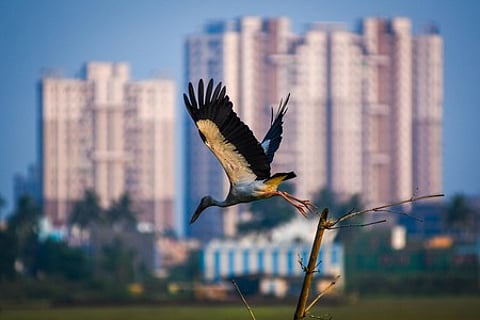

There’s a joke amongst environmentalists: when you are searching for wildlife, look at garbage dumps and places where food is thrown.
Birds and mammals, big and small, are likely to be at such places, foraging on the things we have left behind. In Guwahati, you are much more likely to see towering Greater adjutant storks ‘fishing’ at a garbage dump—places steaming with disembodied non-vegetarian waste—than at the adjoining Deepor beel wetland (where the bird can find real, whole fish). For long dumps were considered the domain of the carnivorous or scavenging animals—jackals at garbage heaps at dusk, migratory eagles at landfills in winter. Yet increasingly one is seeing more herbivorous animals at the places we callously leave our waste.
A recent video shows an elephant picking at a huge rubbish heap near Karnataka’s Male Mahadeshwara Hills (MM Hills). The animal is in a sea of plastic, a heart-breaking sight. In earlier instances, elephants have died in tiger reserves after eating plastic thrown around temples. Many more animals may be dying in this manner—elephant carcasses are more prominent (and sometimes found in waterbodies, where the animal goes to suffer its agonising death).
The irony here is that badly disposed garbage is a human problem too, leaching into groundwater, contaminating soil and causing disease. And if municipalities—as well as communities and individuals—won’t solve the problem for the sake of us, they are unlikely to do so for elephants.
Yet precisely for these reasons—for their far-reaching, visible and invisible impacts—garbage is a problem that has to be solved immediately. The scale for re-use and recycling needs to be made larger, plastic needs to be reduced, and segregation needs to be made more accessible (and fashionable). This has to be done nationally, even as the global plastic treaty has fallen through.
Growing up, there was always one area—usually stony, dry, and perhaps with a depression—that people designated as the local garbage spot. Everyone went there to throw garbage, municipal dumps be damned. It was as if the majority had decided that that particular spot needed to be publicly condemned. Of course, designated municipal dumps themselves are at fault too—often made close to wetlands, ecologically sensitive areas, and hills.
Garbage does not ‘go away’ after we have thrown it away. Like horrible secrets, garbage will re-emerge at the worst of times and places.
Several times, on visits to forests, I have witnessed remnants of our modern civilisation: a plastic bag, strung up a tall tree, hanging like a dirty lantern, there for posterity, or till an unfortunate bird gets tangled in it.
And after inundations by rivers, riversides and their vegetation get covered by plastic and other waste—the river’s way of returning all that is thrown in the water, and ultimately into the sea. There is an old story of a fish’s stomach revealing a mythical ring. Today, the fish’s stomach will likely reveal microplastics.
Each year, I watch mynas—Brahminy mynas, Common mynas—build nests in summer. The nests are made with twigs and leaves, but often also with bits of plastic. It’s hard to blame the birds, when single-use plastic is so omnipotent that it feels like a norm. One day, the nest will be all plastic. In the mean time, it is time to clean up.
Views expressed are personal
