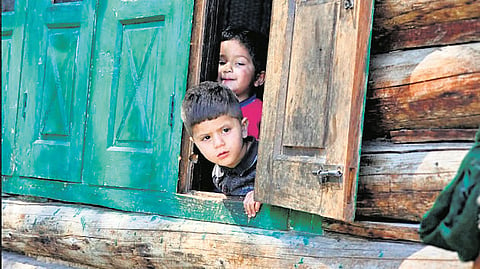

On a crisp afternoon in Gurez Valley in Kashmir, the steady rhythm of an axe rises above the murmur of the Kishanganga River. Every measured strike sends curls of fragrant timber spiralling to the ground as 65-year-old carpenter Abdul Majeed Khan pauses to run his hand over a freshly carved beam. Around him, towering mountains stand witness to a craft that has shaped this valley for centuries. “We don’t use bricks and cement. Our houses are only made of wood, and that is the uniqueness of Gurez Valley,” he smiles. For Majeed, this is not simply carpentry. It is an act of preservation.
Nearly 125 km from Srinagar, Gurez Valley has long remained one of Kashmir’s most secluded landscapes, cut off by heavy snowfall for months every year. Home to the Dard-Shin community, the valley has nurtured a distinctive tradition of building homes entirely from locally sourced timber, using construction techniques handed down through generations. The houses are perfectly adapted to life in the mountains. Built to withstand winters when temperatures plunge to minus 10 or 15 degrees Celsius, the timber acts as natural insulation, keeping interiors warm during snowbound months and pleasantly cool in summer. “Our houses are our pride,” says Bashir Ahmad Teroo, a resident. “We cannot find the same comfort in concrete houses.”
That emotional connection is shared across the valley. For many families, every house carries memories of grandparents who built it, neighbours who helped raise its beams, and generations who have sheltered beneath its wooden roof. Majeed has spent 45 years ensuring that tradition continues. “These houses take 10 to 15 days to build, depending on the design,” he says. “This is my only source of income, and now my son is also working with me.” His son represents a new generation learning skills that many feared might gradually disappear. As modern construction materials become more accessible, the temptation to replace timber with concrete has grown. Yet in Gurez, many residents believe that preserving traditional architecture is inseparable from preserving the valley’s identity. “We are trying our best to preserve this because it represents who we are,” says Rayees Ahmad Margay, a resident.

Families repair old structures using traditional methods, carpenters teach younger craftsmen the techniques they inherited, and conversations increasingly revolve around protecting the valley’s unique architectural character
That sense of ownership has transformed conservation into a community effort. Families continue repairing old structures using traditional methods, carpenters teach younger craftsmen the techniques they inherited, and conversations increasingly revolve around protecting the valley’s unique architectural character. Today, the effort to save these homes has also become one of the valley’s biggest attractions. As travellers increasingly seek authentic experiences over conventional holidays, Gurez’s wooden houses have become destinations in themselves. “Tourists appreciate the design and the feeling they get while staying in them. It feels like home to them,” says Huraib Lone, a local homestay host.
Visitors agree. “This is something new for us,” says Ankita, a tourist from Bengaluru. For the community, tourism has become an unexpected ally. Every traveller who chooses a wooden cottage instead of a concrete building reinforces the value of preserving traditional architecture, creating livelihoods while giving residents another reason to protect what has always been theirs.
As evening shadows stretch across the valley, Majeed lifts another beam into place. Around him, the scent of fresh timber lingers in the mountain air—a reminder that in Gurez, every wooden home is more than shelter. It is a living archive of craftsmanship, climate wisdom and community memory, carefully preserved by the people who continue to build not just houses, but a future rooted firmly in their past.