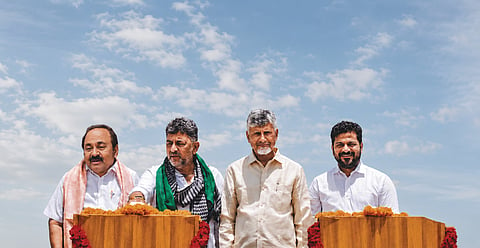

DK Shivakumar is comfortable with power. You can see it. Walk into the expansive, wood-lined chief minister’s chamber in Vidhana Saudha and you know who is the alpha of the omega of authority. The room is packed with ministers, bureaucrats, politicians, and aides, all part of the voltage of energy charging the atmosphere. The Chief Secretary is there, rapidly going through notes to be shown to the boss with the efficiency of an expert long used to the power of papers. Shivakumar, initialised as DKS, is at the head of the conference table, filling the chief minister’s chair, listening carefully to officials, asking for clarifications and occasionally interrupting in a voice that is neither soft nor harsh. It is the voice of a politician which can be raised to the highest octave of a battle cry; of a negotiator who cajoles his foes and reassures allies; of a leader who connects with adoring audiences, walking alongside crowds with the ease born of grassroots camaraderie, enjoying the adulation, showers of rose petals, and followers feasting on the echo.
It is also the voice of power, with a tonality that took him many years and many wars to be heard by New Delhi and took him to the pinnacle of government in Karnataka—one of the three formidable Southern bastions of the Congress. Barely over a month has passed since Siddaramaiah stepped down after three years in the CM’s chair; he did so reluctantly after the gentle, and not-so-gentle prodding from 10, Janpath and Priyanka.
“What’s the plan? How will your government be different from previous governments?”
DKS smiles almost bashfully. “I’m focused on 2028, that is all for now,” he says. Skilled veteran politicians can pack a lot into the banal. 2029 is when Karnataka goes to the polls and when the DKS style of governance and politics are put to the test. It is the year an electoral victory would ensure his place in the Congress galaxy, where Rahul Gandhi—the prince gave his newest chief minister only five minutes at Bengaluru airport—would have to acknowledge as a mass leader matters more than any armchair advisor. 2029 is also the year when the fate of the BJP’s Southern push will be decided.
So yes, focusing on 2029 means more than what meets the eye.
What met the eye, last week was DKS being detained at the Congress rally outside the PM’s house. Politics means reading the tea leaves in nuances: significantly his first act of defiance over a national issue since he became chief minister was protesting against the Modi government along with the Gandhi siblings and Opposition leaders. But before all that, what met the eye had happened on the evening of June 3, at Glass House of Lok Bhavan in Bengaluru: a 64-year-old man from the village of Doddalahalli taking the oath of office as Chief Minister of Karnataka. He held a copy of the Constitution of India. He invoked the name Sri Veera Gangadhara Ajja, a highly revered late saint associated with the Shri Kadasiddeshwara Mutt at Nonavinakere in Tumkur District. In attendance were the heavy hitters in opposition politics: Rahul Gandhi, Mallikarjun Kharge, Kerala chief minister VD Satheesan and Telangana’s chief minister Revanth Reddy. The occasion marked the culmination of a power-sharing arrangement between Siddaramaiah and then deputy Shivakumar which had been the subject of political speculation since the Congress won 135 seats—a majority no single party has managed in Karnataka in recent memory. With the instinctive understanding of Southern tradition, he sent the precise signal that politics is for enemies, but there are no enemies in politics. Hours before his swearing in, he visited Yediyurappa to seek his blessings. Then the ailing Deve Gowda at home. A benediction sought from elder statesmen that signified his brand of politics. DKS recalls Karnataka was the turning point in the last few years, when the South steadily moved towards the Congress. He sees a ripple effect spreading, as the “confidence and momentum we built here travelled to Telangana”. He is sure Karnataka showed that the Congress can win, govern and deliver. And in Kerala too, people wanted a credible alternative, and the Congress presented one.
South Bloc
A Revanth Reddy
Rose to the top after steering the Congress to a surprise victory over the BRS in 2023, transforming himself into the Telangana’s most prominent Congress leader
VD Satheesan
Satheesan revitalised the party with an aggressive campaign against the LDF government, emerging as the Congress’ strongest chief ministerial prospect
C Joseph Vijay
The actor entered politics by launching the TVK and quickly positioned himself as the credible alternative to the DMK and AIADMK
N Chandrababu Naidu
Returned as Chief Minister after the TDP-led alliance’s landslide win in 2024, reaffirming his stature as Andhra’s most experienced political strategist

The Village Boy Who Understood Power
The South matters today more than ever in the North-dominated scheme of things, both for the Hindutva project and the Congress Idea of India. The Grand Old Party has been shattered in North India by Amit Shah’s predatory political strategy and the organisational muscle of RSS. The BJP surge is being pushed back by the below-the-Vindhyas brigade: in Karnataka led by DKS, in Telangana by Reddy, in Kerala by Satheesan, and the Congress in alliance with Vijay in Tamil Nadu. In the 2023 election, marshalling BJP’s strategy was the astute BL Santhosh, monitored by Modi-Shah. Now, leaning back in a comfortable white leather couch in the ante room of his office, DKS’s forehead shows no worry lines; “A lesson to learn about the South is this: the leadership worked together, the organisation worked together, and the people responded. Today, the South is demonstrating that welfare, development and economic growth can go hand in hand. I think people across India are watching that model. Good governance has no language barrier. Govern well, people notice, whether they are in the South or the North.”
To enable delimitation, the BJP is likely to get enough votes for a 3/4th majority in Parliament. And the South could lose both political clout and relevance vis a vis the North. A question frequently asked of Shivakumar concerns his plans in North India. He invariably responds with a laugh, saying, “My responsibility today is very clear: to strengthen the Congress in Karnataka and deliver this state once again to Madam Sonia Gandhi, Mallikarjun Kharge ji and Rahul Gandhi ji in 2028. This is my karmabhoomi. This is where my energies are. If I do my job well in Karnataka, I am strengthening the Congress nationally. That’s how I look at politics.”
In 1964, when Jawaharlal Nehru died, the most powerful figure in the Congress was a politician from Virudhunagar in Tamil Nadu who was largely unknown to the Hindi speaking populace, but not in his own party: Kumaraswami Kamaraj. His career was stellar: Chief Minister of Madras from 1954 to 1963, Congress President between 1964 and 1967, the force that propelled Lal Bahadur Shastri and later Indira Gandhi to the Prime Minister’s chair. When the succession question arose after Nehru’s and Shastri’s passing, every senior Congress leader wanted Kamaraj. He refused. His reason: he knew neither English nor Hindi, and understood that India’s prime minister must be proficient in at least one of these languages.
Shivakumar, more than half a century later, operates in a similar milieu. But with a difference. He is comfortable in English. He has operated across multiple northern states. Watching him work the crowd, it could be an Uttar Pradesh or Maharashtra or Rajasthan politician from the old Congress days when proximity was the rule, not the security cordon. DKS has the kind of pan-Indian network that Kamaraj never had. The only Southern exception was PV Narasimha Rao, who arrived at the Prime Ministership as the least expected choice.
In the Congress historically, a South Indian can become a national powerhouse only as an outsider, often by accident, always indirectly, and sometimes without the institutional loyalty that his own loyalty to the institution deserved. A Samajwadi Party MP in Lucknow—who refuses to be named—says a Southern leader with pan-India acceptability is better than the base-less Congress netas who only have Rahul Gandhi’s patronage as credentials. That Congressman could be DKS—a first among equals.
In the Congress itself, a South Indian who becomes a national powerhouse does so as an outsider, often by accident, and sometimes without the institutional loyalty that his own loyalty deserved
BJP’s Southern Discomfort
The BJP and its National Democratic Alliance govern 19 states and two union territories. In this landscape of aggressive saffron, the South stands out as the visual force of a natural boundary with a different political hue. What is striking is these states are not held together by a single party or a single leader: Congress governs Karnataka, Kerala, and Telangana; TDP Andhra Pradesh in alliance with the BJP but retains an independent southern identity. Vijay captains Tamil Nadu and is no BJP supplicant. These are not agents of any national HQ. They are distinct, locally rooted political formations that have arrived at their current positions through their own histories and constituencies. South India’s Congress Chief Ministers do not owe their authority, popularity, or electoral victories to Rahul. They owe them to themselves. This is what brings out the sheer joy of a political fight in leaders like DKS. In his state he has turned on its head the SIR—considered a BJP weapon used in states like West Bengal and Assam. Union ministers HD Kumaraswamy and Shobha Karandlaje have asked the Election Commission to scrap the exercise alleging misuse. For DKS, the issue is not Karnataka versus the BJP. “It is every Indian’s right to vote versus the risk of losing that right. We had seen what was happening in other states, particularly election-bound states, so we prepared early. No citizen should lose their vote because they didn’t know the process. Democracy should make voting easier, not harder. That has been our approach from day one.” Touche.
The BJP surge is pushed back by the below-the-Vindhyas brigade: the Congress in Karnataka led by DKS, in Telangana by Reddy, in Kerala by Satheesan, and in alliance with Vijay in Tamil Nadu
Why South Indian Leaders Shy Away
Powerful Southern emperors and kings have conquered and ruled northern lands: King Rajendra Chola’s massive military campaign crossed the Deccan, defeated Kalinga and marched into Bengal. The Rashtrakuta Dynasty that ruled present-day Karnataka, captured Kannauj, now in UP, in around 800 CE. Naidu is a far cry from a Chola. In 1996, when the United Front offered him the Prime Minister’s post he sought the advice of his son Lokesh, who was a Class X student then. Lokesh told him the permanent job of the Chief Minister is better any day than going for a temporary post like Prime Minister. There is something almost Shakespearean in a Class X boy deciding the course of Indian political history.
At 74, Naidu is the essential ally of any ruling party in Delhi, but not its essential leader. In 2024, his 16 seats were the margin between a BJP majority and a BJP coalition. Even at its peak, TDP contested in only Andhra Pradesh and the maximum it can deliver is 25 seats from there: a prime minister needs 272. The moment TDP becomes a truly national party, it would cease to be TDP.
Jayalalithaa indirectly governed Delhi, and only on her terms. No government at the Centre could be formed without the support of either the DMK or the AIADMK for the past 22 years. These two Tamil parties used their undeniable leverage to extract ministries, concessions, and protection. Muthuvel Karunanidhi, who scoffed at the Sanskrit-inflected national discourse of Congress, reportedly disliked going to Delhi: why should he, when in 2008, his critical support to the Congress helped the UPA to stay in power after the Left pulled out protesting the India-US nuclear deal? Tamil Nadu has 39 Lok Sabha seats. Andhra Pradesh has 25. Karnataka has 28. Kerala has 20. Uttar Pradesh alone has 80 MPs. Projections suggest that a reconstituted Lok Sabha would feature a whopping 143 seats for UP (up from 80 now) and 79 for Bihar (up from 40), while Tamil Nadu would add just 10 more seats and Kerala none at all. MK Stalin had called it a “sword hanging over the South”.
DK Shivakumar is the newest public entrant into the Southern bloc. He has relationships with the southern leadership, with the Congress high command in Delhi, and most crucially with Naidu, whose TDP shares the bloc’s federal concerns. If Shivakumar governs Karnataka well, delivers on Bengaluru, honours Siddaramaiah’s welfare guarantees fiscally, he would be a formidable foe to contend with.
The BJP is known to anticipate even before its enemies know what is coming. In hindsight, it isn’t surprising that DKS was arrested by ED in late 2019 for money laundering; lacking evidence, he was released on bail. That release only bonded him deeply with Sonia who visited him in Tihar Jail. As she watched his progress then on, she realised DKS could be more than a loyalist. So did Priyanka. When the crucial moment came for Siddaramaiah to make way for his deputy, AICC sources spoke of a family power struggle. Sonia and Priyanka put their foot down; Siddaramaiah has to go. A frustrated and furious Rahul, in the end, was supposed to have shrugged and told party boss Kharge that he was washing his hands of the affair and the party could choose whosoever “it wanted”. But DKS is emphatic there was no rift in the family. “Differences between brother and sister are impossible. They always work together. And will continue to do so.”
But this is not what politicians in the Sonia camp—yes there are three camps—say about the complex family equation. A young politician from UP, who had worked in a senior position on Sonia’s parliamentary staff, insists the sister is boxed in. “She has been shown her place. Stick to Wayanad. Don’t interfere in national party affairs.” This is the political topography DKS has to navigate. The mass popularity of the eight-time MLA has earned him enemies, who were—and still are—happy to see him hobbled. But he wasn’t.
The Troubleshooter Arrives
But the party, even Rahul, knows Shivakumar is needed. He personifies the particular kind of political animal that every large party quietly depends upon but rarely acknowledges publicly: the enabler. He is the person who keeps a coalition intact when it is fraying from inside, who can persuade wavering MLA to stay on, and one who understands that politics is not just about ideas but about the mundane, essential floor plan of loyalty. In 2002 he sequestered Congress MPs in a resort and rescued Vilasrao Deshmukh’s Congress government. To save Ahmed Patel’s Rajya Sabha seat, he moved 42 Gujarat Congress MLAs to his Bengaluru resort to stop them from defecting to BJP. He also represents the dying breed of Indian politician whose stories are as colourful as his scarves. He would recall what turned out to be a prophecy: “When Bangarappa was making a portfolio for his Cabinet, he made me write a list. He told me, ‘DK, I was Jail Minister and became a CM now. You should also become CM. Take this (Jail) portfolio.’” His loyalty is legendary: he stayed committed to mentor SM Krishna who “treated me like his son politically”. He lobbied Narasimha Rao for a Rajya Sabha seat for Krishna; a reluctant Rao denied a ticket to a sitting MP and gave it to Krishna.
One of the less-remarked achievements of Shivakumar’s political career is how he has navigated the sensitive terrain of Vokkaliga community politics. This dominant caste is roughly 16 per cent of Karnataka’s population and the loyal bastion of the Gowda dynasty. DKS struck a chord with Vokkaliga voters with the help of the powerful Karnataka Vokkaligara Sangha organisation, which he nurtured from the moment he became KPCC president. JD(S) chief Kumaraswamy had congratulated Shivakumar following the swearing-in ceremony. His message was notable given the longstanding political rivalry between the two Vokkaliga leaders. But what it also demonstrates is Kumaraswamy, now a Union Minister in the NDA government, is in a position of relative weakness. His JD(S) won only 19 seats in the 2023 Karnataka election—the party’s worst performance since its formation. His son Nikhil has now lost three elections; two of them in constituencies vacated specifically to give him a safe seat. A Vokkaliga Chief Minister of Karnataka is the one development that threatens the Gowda family’s remaining claim to political relevance the most. Kumaraswamy’s congratulations is the acknowledgement of this threat, dressed as courtesy.
DKS is the person who keeps a coalition intact when it is fraying from inside, and one who understands that politics is not just about ideas but also about the mundane
The Religious Establishment’s Verdict That Helped
The most institutionally significant non-political endorsement of Shivakumar’s elevation came not from a politician but from a religious leader, that too, six months before his swearing-in. The head of the Adichunchanagiri monastery, the most powerful seer of the Vokkaligas, declared Shivakumar should be Chief Minister in November 2025. The political implications were enormous. The cross-party relationship in Shivakumar’s own Congress universe that is fraught with anxiety is not with the BJP but with the Mallikarjun Kharge, the 82-year-old Dalit leader from Kalaburagi who has known Karnataka politics longer than Shivakumar. In 2025, Kharge publicly complained: “As Congress Legislature Party Leader, I had brought Congress party to power. I had worked hard to bring the party to power, but SM Krishna was made the Chief Minister.” The 1999 decision is the exact same dynamic Shivakumar experienced in 2023, when Siddaramaiah was elevated despite Shivakumar’s claim. Both men had to wait. Kharge is now AICC president. Shivakumar is now Chief Minister. Their relationship is managed with extraordinary care on both sides. But not all relationships are.
In the last week of November 2025, Shivakumar reportedly spent several days trying to reach Rahul Gandhi by phone. He had been waiting for his time to come. The halfway mark of the government’s term—November 2025—had come and gone. Siddaramaiah was still Chief Minister. After nearly a week of futile attempts, Rahul did reply, but a WhatsApp message. “Please wait, I will call you.” The call never came. Shivakumar packed his travel bag to Delhi to meet with Sonia Gandhi. When asked about his relationship with the high command in the weeks before his elevation, he answered : “Sonia Gandhi spoke to me over the phone. She has a lot of trust in me since the beginning… She has belief in me. I have assured that I will take everyone together.” It is clear DKS does not claim ideological alignment with the high command’s vision; he cites trust, of the specific and personal variety, given by a specific woman since a specific beginning.
The South is watching that beginning. So is Delhi. DK Shivakumar, has an unapologetic penchant for luxury: he runs a sprawling business empire worth over Rs 1,100 crore. His watches are Cartier and Rolex. His signature dress code is the designer scarf casually flung around his neck: Prada, Ferragamo, Burberry, Louis Vuitton, all of which lend a distinctive splash of colour to the Congressman’s uniform of spotless white khadi. It is his declaration that personal style can mix the idioms of time and taste. And geography.
Perhaps not in a white tee shirt.
The King Makers
1960s- Federal Force- K Kamaraj
The original ‘kingmaker’ of independent India, Kamaraj used his influence as Congress President in the 1960s to steer the succession of both Lal Bahadur Shastri in 1964 and Indira Gandhi in 1966, shaping the course of national politics
1980s- Coalition Captain- M Karunanidhi
The DMK patriarch dominated Tamil Nadu politics for nearly five decades, using his party’s parliamentary strength to play a pivotal role in coalition governments at the Centre, backing both the NDA and the UPA at different times
2000s- Mandate Maker- J Jayalalithaa
The AIADMK supremo combined a formidable electoral hold over Tamil Nadu with significant leverage in New Delhi, making her party an indispensable ally in the coalition era of the 1990s and 2000s
2026- Regional Ruler- N Chandrababu Naidu
The TDP chief has been one of India’s most enduring coalition strategists, playing a decisive role in the United Front government in 1996, backing the NDA under Atal Bihari Vajpayee, and once again emerging as a kingmaker by supporting Narendra Modi’s coalition in 2024