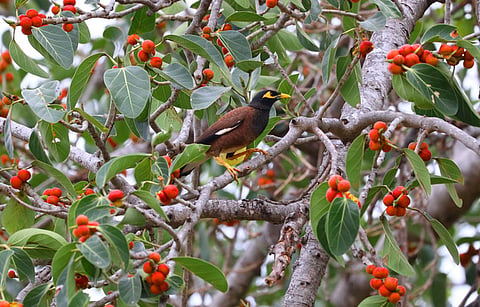

In the mid-morning light, a Common myna flew above my head, shrieking. Its beak was bright yellow and angled like a spear, intending to attack its cousin, a Brahminy myna. The reason for the avian commotion was an old, rusted pipe that stuck out from my building like a forgotten periscope.
Each year, around Mother’s Day, a Common myna pair claimed the pipe. A little later, as summer rose, they raised their brood. Each time they sensed their parents, the chicks would shriek with the abandon of a once-in-a-lifetime bounty—the rest of their lives would be spent with a quieter profile that didn’t attract attention. As chicks though, their ravenous hunger was their parent’s problem. And ours. Their calls punctured mornings, noons and evenings.
This year, the less common Brahminy myna had taken the pipe. The other mynas would watch, squabble, and retreat. A precious nesting ‘hole’ had been taken, and another would need to be found. Then, would follow the task of nest-building, finding food, and feeding impatient chicks. Occasionally, there would be recces done by House crows and Rufous tree pies, who would be delighted to snap up the chicks as a snack. As I observed the new occupants of the rusted pipe, my phone pinged.
It was the time of the year for Mother’s Day commerce—websites with 20 per cent off, showing your mother you cared for her only if you bought her expensive (but marked down) stuff. There were spa days, discounted bags and shoes, holiday packages. There were discounts for daughters too, so both women could match, if they didn’t already have matching faces and hair. Then there were the other kind of messages, showing moms in halos, with AI poetry (to be clear: everyone should write poetry, even if it’s bad, but bad AI poetry is a little much). It’s a May march we are familiar with. But one thing continues to stick out every year: the idea of the mother rather than the mother herself.
People who bickered with their moms, smothered more than mothered, made peace for a day. Mothers hinted heavily that they are better than the average human.
It was, as always, sanctimonious at worst, and funny at best.
Meanwhile, nature continued her dance. A Yellow-footed green pigeon came to a False Arjuna tree, again and again, to break off twigs for her nest. Another bird in an office I visited laid eggs and began incubating them, doing her best to ignore masses of people below the boughs. In the heat of June, at the hottest time of the year, birds search for soft insects to feed their young.
There would be no appreciation, no posts and certainly no discounts. Everything would be true, absolute, and hard won.
I am often asked why I enjoy looking at nature. One reason is the contradictions in it—nature is brutal and calming, all at once. Another is that the materiality in nature is non-commercial: a rusted pipe, a cardboard box, and leaf litter are all important for wildlife. Nature teaches us values beyond the marketplace and conjoins us with the ordinary, lived-in object. In his lovely book, An Immense World, author Ed Yong writes how wild animals cherish dark skies and chemical-free areas; their senses attuned to natural rather than chemically modified states.
And then there is my favourite reason: the fact that nature carries on, with no bells and whistles. There is no time or predication for woe or sanctimony, only the act of doing. And so, I vow to love my mother as an act of doing, rather than positioning.
Views expressed are personal

