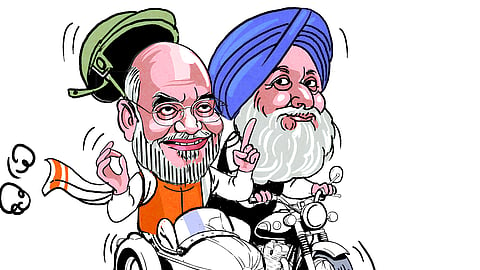

The coming together of the BJP and the Shiromani Akali Dal (SAD) ahead of the 2027 Punjab Assembly elections marks the revival of a historic political relationship. It offers an opportunity to rebuild trust, restore Punjab’s economic strength, and reconnect its regional aspirations with India’s larger development vision. The timing is significant, coinciding with the 556th Parkash Purab of Sri Guru Nanak Dev Ji. His timeless message of Sarbat da Bhala—the welfare of all—along with equality, brotherhood and service, provides an enduring foundation for cooperation and collective progress.
The BJP and Akali Dal share a consequential political history. Their alliance, formalised in the 1990s, brought together two parties with distinct but complementary strengths. The Akali Dal has deep roots in Punjab’s Sikh religious, cultural, and agrarian landscape, while the BJP has traditionally drawn support from urban populations, traders, professionals, and other sections of society. Together, they demonstrated how cooperation across communities and constituencies could provide political stability and effective governance.
The alliance governed Punjab in 1997 and again from 2007 to 2017. Its separation in 2020 over the farm laws was a difficult chapter. The subsequent repeal of the laws and continued political dialogue created conditions for reconciliation. The decision to reunite reflects the importance of moving beyond past disagreements and recognising the larger responsibilities towards Punjab. The challenge now is to translate political understanding into public confidence. This cannot be achieved through electoral arithmetic alone. The concerns that led to the separation must be addressed with sensitivity, particularly farmers’ interests, Punjab’s regional aspirations and its distinctive cultural identity. Mutual respect, organisational coordination, and a credible common programme will be essential.
Punjab needs a renewed economic vision. Agriculture remains the backbone of its economy, but groundwater depletion, dependence on a narrow cropping pattern, and pressure on farm incomes demand urgent attention. Crop diversification, food processing, agricultural technology, and better market opportunities must become central to the state’s development agenda. Constructive engagement with farmers is indispensable to this process.
The future of Punjab also depends on its young people. Unemployment and the drug menace have placed an enormous burden on families and communities. A comprehensive response must combine effective policing, intelligence networks, financial investigations, rehabilitation, and employment generation. Tackling the drug trade cannot be reduced to law enforcement alone; it requires sustained social intervention and economic opportunity. Industrial revival is equally important. Punjab has the entrepreneurial capacity, skilled workforce and strategic location to attract investment in information technology, pharmaceuticals, textiles, food processing, renewable energy and manufacturing. Reviving industrial clusters, promoting startups and strengthening skill development can help make the state a preferred destination for enterprise rather than a place from which its young talent feels compelled to migrate.
Punjab’s international border gives it a special place in India’s security architecture. Border infrastructure, modern surveillance, connectivity and economic opportunities for border communities require sustained attention. Security and development must proceed together, ensuring that residents of border districts are partners in progress rather than merely inhabitants of a strategically sensitive region. The renewed partnership also offers an opportunity for stronger cooperation between the state and the Union Government. Punjab should be an active participant in India’s growth story as the country moves towards its 2047 development ambitions. Its agricultural contribution, industrial potential, human capital and strategic location make it indispensable to national progress.
Punjab’s greatest inheritance is its tradition of communal harmony and brotherhood. Its farmers have fed the nation, its soldiers have defended its borders, and its entrepreneurs and freedom fighters have contributed enormously to India’s progress. The renewed alliance must draw upon this legacy, bringing together rural and urban constituencies, farmers, traders, professionals and young people around a shared development agenda.
Ultimately, the success of this reunion will depend not on the announcement itself but on what it delivers. Political differences can be overcome through dialogue, but public trust must be earned through performance. Punjab needs employment, agricultural security, industrial investment, social harmony and a future in which its young people can fulfil their ambitions at home.
This is an opportunity to reconnect Punjab’s regional aspirations with India’s national development journey. A prosperous, secure and socially harmonious Punjab will not only reclaim its place in the country’s growth story but also make a significant contribution to the vision of Viksit Bharat by 2047.
Posts on X: @sumeetbhasin
