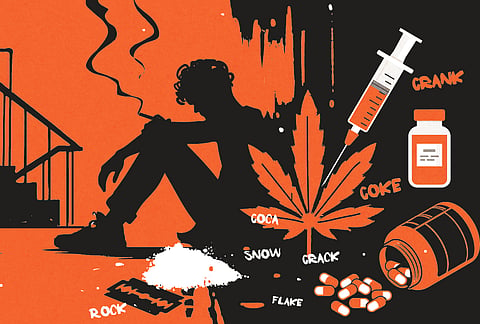

When the film Udta Punjab arrived in cinemas a decade ago, it provoked denial, institutional anger, and bitter debate. Critics dismissed its bleak portrayal of youth hollowed out by syringes and cheap heroin as sensationalist fiction. Ten years later, that film looks understated rather than exaggerated fiction. The crisis is no longer Punjab’s alone. It has spread across India, infiltrating premier campuses, tech corridors, coastal villages, and industrial hubs with quiet ruthlessness.
India occupies a perilous geographical position between two major illicit narcotics epicentres: the Golden Crescent of Afghanistan, Pakistan, and Iran to the west and the Golden Triangle of Myanmar, Laos, and Thailand to the east. With the world’s largest young population, who are mostly jobless and unemployable, we are a gold mine for the narcotic business. Pakistan uses narcotics as the most effective weapon to destabilise our future. Low-cost drones drop consignments of heroin and methamphetamines across the western plains under cover of night. Deep-sea dhows dump massive shipments into international waters off the western coast, while dense jungle trails facilitate trafficking across the Northeast.
History provides stark warnings about what happens when narcotics take root inside a society. In Mexico and Colombia, drug syndicates hollowed out the state from within. India stands at a critical juncture where transit pipelines have evolved into lucrative domestic consumer bases, mirroring the early stages of Latin America’s descent.
Comprehensive research by the Ministry of Social Justice and Empowerment in collaboration with AIIMS reveals that over 3.1 crore Indians use cannabis products, and 2.3 crore consume opioids. States such as Punjab, Haryana, Mizoram, Manipur, and Nagaland record opioid addiction rates multiple times higher than the national baseline. Enforcement agencies, including the Narcotics Control Bureau, seize thousands of kilograms of synthetic stimulants, heroin, and diverted pharmaceutical drugs every year. In Kerala, annual registered cases under the Narcotic Drugs and Psychotropic Substances Act exceeded 36,000 in 2025.
The nature of the poison has also transformed. Traditional plant-based substances have been overshadowed by synthetic chemicals. These drugs carry minimal odour, fit easily into school bags or courier parcels, and escape casual detection. This hidden epidemic operates behind closed apartment doors, affluent hostellers’ rooms, and nightlife venues, masking severe physical degradation behind ordinary suburban facades.
Across urban and semi-urban India, educated youth grapple with severe structural unemployment, underemployment in the gig economy, and relentless competitive stress. Meanwhile, constant digital connection often hides deep loneliness. Many young people often use drugs to numb their anxiety and find a temporary sense of happiness.
The public conversation regularly celebrates Gen Z for its political consciousness, digital literacy, and democratic enthusiasm. Yet society remains willfully blind to the parallel reality: a generation quietly burning itself out under the weight of mental isolation and chemical dependency. Celebrating their democratic awakening while ignoring their addiction crisis is dangerous hypocrisy.
State governments have begun scrambling to contain the fallout. The Kerala government and its Home Ministry launched Operation Toofan, deploying police, excise, and state intelligence to disrupt supply lines. The drive has generated thousands of arrests and substantial seizures of commercial-grade MDMA and synthetic contraband near educational campuses. While it has achieved commendable progress, eliminating this menace remains almost insurmountable. Most of the crimes that happen in Kerala are related to drug addiction. For almost a decade, the narcotic mafia has been closely linked to political parties, the film industry and goonda gangs and weeding them out is going to be a Himalayan task. These enforcement measures, while necessary, expose an uncomfortable reality: states like Kerala have awakened late to the threat.
Police raids and seizures, while vital, are merely superficial treatments for a systemic rot; they can disrupt retail rings but cannot cure the soul of a nation in the grip of addiction. Families must break the silence of shame, communities must rebuild lost support systems, and religious bodies must leverage their moral authority to guide the youth away from chemical escapism. Only a united front can confront a menace this pervasive.
This moment represents an existential peril that requires families, communities, and religious bodies to build a united front against the rot of addiction. There is profound concern regarding the evidence of narcotic influence infiltrating the police and enforcement agencies, which necessitates that we cleanse our institutions with the same ferocity used against the cartels. We must look to the aggressive economic and security pressures employed by the US in Mexico and Latin America as a template for tackling such a pervasive threat. Ultimately, we must treat this gathering darkness as a national crisis that demands immediate and uncompromising action to salvage our youth and protect the future of the nation.
mail@asura.co.in
