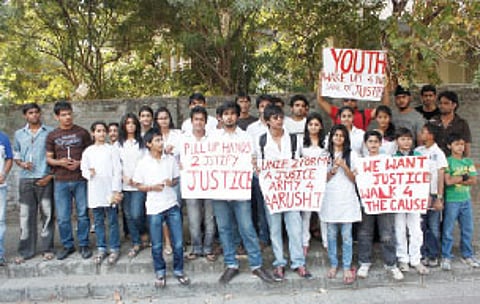

The verdict of the special CBI Court on the Aarushi Murder case in Noida was delivered last week, nearly six years after the event. With appeals, the case may be alive for quite a few more years. There have been many other sensational cases in recent years—Nirbhaya, Jessica Lal, Tandoor murder case, to mention a few. All these and many others were centered around Delhi, very high profile with much media interest, and investigated by the highest investigating body in the country, CBI. The theme of this piece does not directly relate to these cases—rather on the issue of ‘justice delayed is justice denied’.
In the Tandoor murder case, there really was only one significant witness. Even then the case took 10 years or more for the first verdict, and its confirmation at higher levels. What would have happened if the only witness had died, or had been killed, or just bribed—the murder would have gone unpunished. We can multiply this situation a thousand times. Even the ‘day-to-day’ hearing of the Nirbhaya case took more than nine months, with all the rigmarole of appeals still to come. If this is the situation in high-profile cases, imagine the situation in the rural areas, small towns, where investigation and prosecution are in the hands of local authorities, where the system is corrupt to the core.
The trial court conviction in just one of the Lalu Prasad cases took more than 17 years—clearly, there is long way to go to finality. The recent Sankararaman murder case, which resulted in acquittal of all 23 accused, clearly is a pointer that the investigation agencies in India cannot be relied to perform optimally. If nearly half the witnesses turn ‘hostile’, what does it say about the quality of the investigative process? If there is no case, it should not have been pursued; if there is a case, we cannot see the ridiculous situation of a farce enacted in the court room. Something is seriously wrong with our investigative apparatus.
The country needs to be grateful to the higher judiciary for upholding democracy and rule of law—judiciary is the one pillar which has stood the test of time, and deserves admiration and praise from the citizen. The country has been ‘saved’ any number of times. This institution has shored up the system, covering up for major weaknesses in the Executive and Parliament. It needs to be stressed though that the institution designated by the Constitution to give ‘justice’ to the citizen is the judiciary; with such large delays in nearly every case, the question arises whether the citizen actually gets justice.
Surely, one cannot blame the judiciary for all the delays. Starting from the FIR stage, the system has broken down and is largely dysfunctional. In many thanas, the GD (General Diary) is not maintained regularly, and is filled up depending on the circumstances and local conditions. The FIR is often auctioned, with the accuser often turning out to be the accused—this is the playground of the highest bidder and the local politician. The quality of investigation is mostly shoddy—glaring mistakes of commission and omission, most of them deliberate, is the norm. This is a rich field for ‘business transactions’ at the field level. The process continues at the prosecution level—unprofessional prosecutors, many highly corrupt, ensure that justice is derailed. The forensic laboratories and other supportive systems are in terrible shape, riddled with corruption and inefficiency; they are an invitation to interested parties to make sure that any possible case will collapse there. Thus, most often when the matter reaches the court, it is often too late to take any suitable remedial action. With a large percentage of crimes getting away unregistered or uninvestigated, and with huge leakages at the investigation/prosecution stages, it will be fair to surmise that there is just punishment only in a small percentage of offences.
It is another matter that the process in the court itself is often dilatory, and frequently dictated by unprincipled lawyers; the issue of probity in many lower courts is also relevant. Witnesses do not want to come forward, as they get sucked in to be engaged for decades in the matter; perjury is rarely punished seriously. Frivolous postponements/adjournments and interlocutory appeals are permitted. Clearly, Salman Khan’s simple trial of a hit-and-run or illegal hunting of the Chinkara should not take decades. The courts ought to have guidelines in reaching final conclusions with time deadlines—not just allow the influential to play around the procedures.
If all the above relate to the criminal cases, the situation regarding revenue and civil cases is appalling. If a case gets settled in a couple of decades, it is a great thing. The system is loaded in favour of the rich—there is little care for the poor in respect of judicial rights.
There is a crying need for reforms. One has not heard anyone seriously talking about changes in procedures, and improvements in systems—we are proceeding as if everything is perfect. While most of the action lies in the province of the executive, the judiciary needs to give attention to this serious issue, and not take a hands-off, detached view of the goings-on in delivery of justice to the common man. tsrsubramanian@gmail.com
