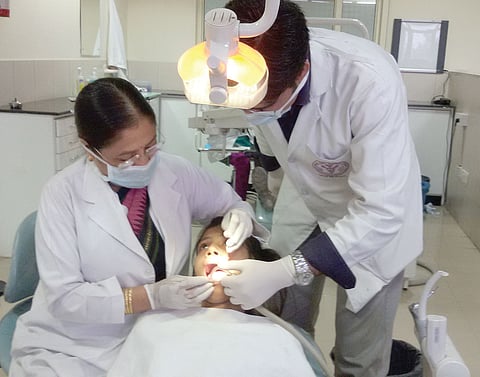

We seem to be on the threshold of astonishing medical innovations. Stem cell-based dental regeneration in laboratory animals holds out the prospect of replicating the technique in humans. But research in the area of regenerative medicine commonly requires an elaborate laboratory set-up and generous funding, a serious impediment. This is where the Department of Conservative Dentistry and Endodontics, Centre for Dental Education and Research at All India Institute of Medical Sciences (AIIMS) in New Delhi scores. It has devised a regeneration-based technique for treatment of an infected tooth’s root canal that precludes resorting to costly lab equipment and biomaterials.
Dr Naseem Shah, chief of the centre and department head, pioneered the method, named SealBio, in 2008. It was granted clearance by the institute’s ethical committee. More than 100 cases treated so far over a five-year period by this method showed high success in resolving the periapical infection, adequate clinical proof to demonstrate its effectiveness. Failed root canals from other places have also been successfully treated. She got a patent on this technique from Australian Patent Office (No. 2010355508, dated January 9, 2014).
The technique’s high success rate derives from a modified cleaning and shaping protocol of root canals and then activation of local stem cells via over-instrumentation with a fine instrument, so as to induce bleeding and form a blood clot, close to the apex of the tooth. The blood clot provides a scaffold into which various indigenous, locally available stem cells can get implanted, grow and start forming hard, mineralised tissue over the apical end of the root sealing the root canal system (hence the name ‘SealBio’). Healing may take a few weeks to some months. It precludes filling up the canal after it is cleaned up with gutta-percha, the rubber derivative used for over the past 100 years for this purpose.
The cost-benefit, half of the conventional method, would help treat vast number of patients requiring root canal treatment. It pre-empts the trauma triggered by uprooting diseased teeth, and the need for an implant or other costly artificial object in the patient’s mouth. The success of the initiative would depend on concerted efforts of the health ministry at the centre and in states to propagate the technique. For, entrenched commercial lobbies are bound to obstruct the wide application of this technique, which takes further an earlier method of ‘revascularisation’ or ‘revitalisation’ of immature teeth, developed elsewhere.
“It certainly qualifies as a breakthrough technique as it reduces the demand on time, sensitivity and cost involved in root canal fillings. Bio-modulation is done without additional cost of biomaterials for scaffold and extraneous source of stem cells and signaling molecules (which require expensive laboratory set-up) needed for regenerative therapies,” says Dr Shah.
It has proven its efficacy in clinical study of over 100 cases and many of these have completed a five-year follow-up. Follow-up of two years is considered sufficient to determine success or failure of treatment. “SealBio technique is for everyone,” says Dr Shah.
Meanwhile, Dr Jeremy Mao, StemSave chief scientific advisor and professor of Dental Medicine at Columbia University Dental Center, New York, has applied for a patent for his tooth regrowth technique via stem cells. Dr Praveen Arany, Assistant Clinical Investigator at the National Institute of Health in the United States, was part of a Harvard research team that recently demonstrated the use of low-power laser to induce dental stem cells to form dentin.
It is a matter of time before the futuristic notion of rejuvenating the human body via natural methods, rather than invasive surgical techniques, becomes a reality.