
Back in the 1990s, there was a popular teleserial on Doordarshan called Mungerilal Ke Haseen Sapne. It was enjoyable to the core, a good fun to watch with family and go along with Raghubir Yadav’s innocent authenticity. In one of them, Mungerilal conducts an operation without any skill and equipment by just pulling a hair from a woman nearby and using it as a knife in surgery.
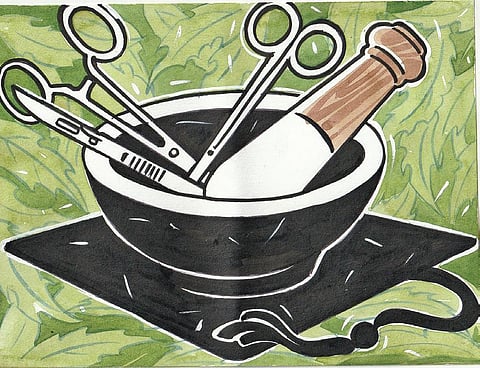
This inspired burst of ‘jugaad’ saves a life, the problem is solved (maybe the child is born) and to all Indians who are suckers for a happy ending, it is all’s well that ends well. The recent guidelines for postgraduate degree in Surgery in Ayurveda course appear to be surrealistically similar. When life starts mimicking art, that is the beginning of phantasmagoric world view. Dreams have something macabre about them and when that dream is peddled under government sanction that is an invitation to a diabolic nightmare. Not that the Ayurvedic stream is not credible enough.
It is. It has medicines for immunity, virility, longevity and many several others. But the history of surgery here is sketchy. Our ancient science can boast of some surgery of yore but modern surgery has advanced exponentially while Ayurvedic surgery has not. Resultantly, Ayurvedic doctors are low on training and practice. One can say anyone can become a surgeon. Sure, with scientific training and practice, it will be possible. But the underlying process is vital. That’s where lies the rub of the matter.
I wonder whether a dozen persons from the gentry will come forward for a serious surgery by an Ayurvedic practitioner. Or at least 1,000 people in the country who can raise their hands as recipients of such a surgery in the past. I may be wrong. But eventually people will seek surgical intervention from a practitioner who is believed to be skilled and who can be trusted. That is where the problem arises. Government can queer the pitch by allowing surgery by the Ayurvedic practitioners just as it keep on creating monopolies in the industry from time to time.
With government sanction, people believe it to be a credible option and submit to such a regime with unknown consequences. Once an Ayurvedic practitioner becomes holder of this degree legitimately, governments are more likely to immediately fill in the vacancies of surgeons by them in the rural hospitals. Scarcity and absenteeism of trained doctors have pushed the rural folks to Rural Medical Practitioners (RMPs), who without training routinely administer antibiotics and steroids.
Non-availability of trained doctors should not propel governments to enable these practitioners to give a service for which they are not ready yet. Already 80 percent of people in rural India do not approach Primary Health Centres (PHCs) and Community Health Centres (CHCs). This may result in abandoning government institutions completely which the corporate hospitals will smack their lips at. Is it the plan to allow the PHCs and CHCs to die an early death? No one understands the inscrutable plans underway.
From Corporal to General could be the motto of the military.
That’s because a military man is more likely to be tested in the crucible of military action. Anyone can do anything though theoretically seductive real life does not play out like that. Market forces, skill and outcome will finally triumph. That will be in spite of the government. But the minimum the governments can do is not to let loose their ideological belief without protecting the common man. This creates a solution which is worse than the problem.
No one will have any problem if Ayurvedic medicine develops pharmacopoeia and assesses efficacy of its medicine based on scientific testing and the results shared. Similarly for such surgeons, if trained and examined by people who have the proficiency and training, it may turn out to be fine. Another method is declaring upfront and taking the consent of the patient that the surgery will be following the Ayurvedic system by an Ayurvedic surgeon which is different from normal surgery.
Without these safeguards and with only unimpeachable faith, Unani surgeons would have taken over in the Middle East and in Europe by now. While barriers to entry created by allopathic surgeons may not be in the best interest of patients, the rag-tag procedure without commensurate skill is also not acceptable. People must be informed and guided rather than being the guinea pigs to be experimented upon. Public policy cannot mimic Mungerilal’s enchanting world.
Satya Mohanty satya_mohanty@rediffmail.com
Former Secretary to Government of India