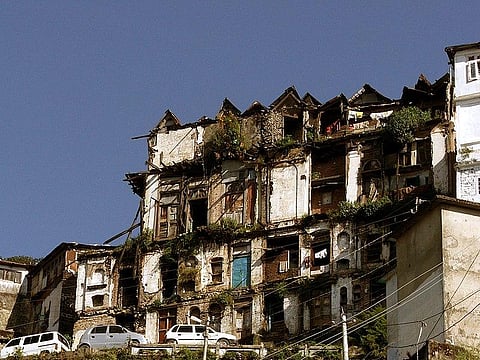

Landour is where I grew up in a family of modest means, which became even more modest when my father retired. And, if truth be told, the closest we came to mountains of money was when across the street came padlocked wooden chests brimming with currency meant for the Mansa Ram Bank from its head office in Saharanpur. With childlike fascination, I saw this transfer being salted away into the bank’s vaults. In the 1950s, the bank crashed. Angry depositors milled around in the street, where wedged in a corner, shattered and forlorn like a broken bird in a storm, sat Choti Dei behenji (that’s what the Sanatan Dharm schoolchildren called her), who had lost everything.
“Her life’s savings are gone,” my father murmured.
I remember in the good old days when Seth Chandersain would set out for morning walks with half the bazaar in tow. There would be silversmiths, tinsmiths, shopkeepers, traders and merchants in all shapes and sizes.
Though our banks do have a chequered history. The first North-West Bank began in 1836 only to fold up six years later. Later, in 1859 came the Delhi and London Bank (also called the Mussoorie Bank). F Moss launched the Himalaya Bank too crumbled in 1884 with the building turned into the Himalaya Hotel. Banks fell like a house of cards and that fate awaited the Bank of Upper India and the Alliance Bank.
Landour’s Kohinoor building used to house Messrs Bhagwan Dass & Company in 1890 with Mansumrat Dass, the owner’s son, as its manager and the first Indian to be nominated to our Municipal Board.
Misfortune came visiting and The Rambler published in 1936: “It is possible that those ‘in the know’ were not aware of a new client they accepted at so precarious a time, but to the everlasting shame of one of these banks, on the eve of its collapse, it accepted the life savings amounting to `64,000 of an old man and caused him to die of a broken heart.”
Not my father though. I don’t really believe he was shattered when the bank collapsed. Not if I go by the stub of his old chequebook, still with me. It shows a balance of `39. Often bazaar gossip, innuendo and loose talk led to these financial upheavals. Someone tipped off the Rajmata of Tehri of a looming cash crunch and she withdrew her considerable deposit triggering a liquidity crisis. Some believe Sethji’s untimely heart failure—two days before the bank collapsed—saved him from certain ignominy.
Had he, in happier times, looked down from his lofty perch onto the road below, he would have seen a little boy studying in a patch of winter sunshine to stay warm. This industrious lad would become the ‘official receiver’ of all the bank’s properties.
The Himalaya Hotel used to house the State Bank of India since 1921 in its Imperial Bank incarnation. Its plush wrought-iron railings imprinted with VI or Victoria Imperatrix—Empress Victoria—continue to remind us of our hill station’s imperial past like the poet who tells us: ‘You may break, you may shatter the vase, if you will, But the scent of the roses will cling to it still.’
Ganesh Saili
Author, photographer, illustrator
sailiganesh@gmail.com
