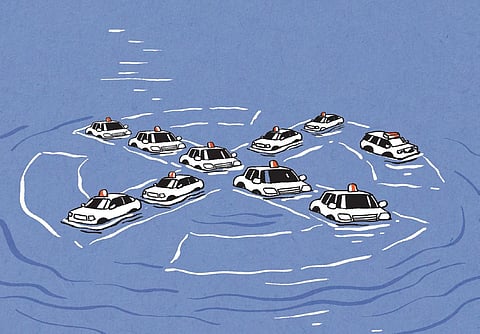

There is a saying in Hindi and other Indian languages that are equally great repositories of folk wisdom. It tells us that for a person with an iota of shame, water that can be cupped in two joined palms is enough to drown: Chullu bhar pani bahut hai sharmdaar insan ke doob marne ke liye. Literal translation implies that if a person has disgraced himself by an act of commission or omission, he/she should retire from public life into oblivion. Such adages have become useless in the times we live in. Those responsible for the inundation of once-great cities, and the transformation of multilane highways into life-threatening ‘canals’, with rainwater mixing with excrescence from overflowing sewers remain invisible only till the floods recede.
The dangling high-voltage electricity wires, slithering poisonous snakes and open gutters that can swallow a pedestrian are only a few of the seasonal hazards that most of us have learned to live in Delhi, Mumbai, Chennai, and Bengaluru, etc. Dirty water seeps into water treatment plants, large mosquito breeding pools are formed in posh localities and dangerous diseases lurk for months after our voluble leaders have verbally ‘turned the tide’.
Some brave souls of this tribe are occasionally spotted on a rubber dingy, secure in a lifejacket ‘supervising’ relief and rehabilitation. Those unfortunate hundreds of thousands who are rendered homeless/jobless are mute spectators of this annual tamasha. Most of them are daily wage earners, immigrants who dwell in shacks in shantytowns on the river bank. For those who survive from day to day on footpaths under open skies, the discussion about causes of flood, and direct and vicarious responsibility for avoidable loss of life and property has no meaning.
For once, we have to agree with the ordinance armoured L-G of Delhi: “This is no time to play the blame game.” Party politics can wait till a semblance of normalcy returns. This hasn’t stopped smart Alecks from hard-hitting wisecracks. As the floodwaters knocked at the gates of the Supreme Court, someone quipped, “Will the honourable lordships now order the ‘threatening’ river to approach the high court first?”
There is nothing new about rivers flowing in spate after torrential rains, breaking their banks and sweeping away bunds and submerging low-lying lands in their course. What is new is our reluctance to learn lessons from past mistakes and refusal to take scientific evidence seriously while making policies for development. ‘Nature’s fury’ is a much-abused cliche to absolve greedy and shortsighted ignoramuses of their complicity in what are essentially ‘manmade disasters’.
Kamayani, the epic Hindi poem penned by Jaishankar Prasad, begins with poignant lines that resonate today: “Himgiri ke uttung shikhar par baith shila ki sheetal chhaon, ek purush dekh raha tha bheege nayan se pralay pravah.” Pralay is the Sanskrit word for the ‘Great Deluge’, an event encountered in many myths. Moses with his Ark saved myriad species to repopulate the earth devastated by unprecedented floods. The man watching the deluge with moist eyes is Manu, who plays
a similar role of the compassionate saviour in Indian lore.
Deluge is another word often used out of context. The aristocratic French lady who pompously pronounced, “Apre moi le deluge” is placed in the company of Emperor Nero who, we are told, fiddled while Rome burned. There are many contemporary leaders who, it seems, live by same the values. They believe that no deluge can wash them off from lofty pedestals. They watch the 'pralays' of their making with dry eyes, advising us gratuitously: “This is no time to cry.”
We have no patience with critics of our Prime Minister who have found fault with his foreign tours when Delhi reeled under an unprecedented submersion. The PM of India shouldn’t be reduced to the level of a superintendent engineer in the Public Works Department or officer in charge of monitoring constantly the water level of Yamuna over the danger mark. Modiji has unmatched charisma and approval ratings. But this doesn’t mean that all his other ministerial colleagues are mere puppets who are helpless to act on their own in his absence. The portly Home Minister, a man of substance, held meetings with officials to cope with the crisis as it unravelled. But these had little impact till the army was deployed. Poor Arvind Kejriwal had to shout himself hoarse pleading the PM to intervene, lest the nation’s image is irreparably dented on the eve of the G-20 summit.
People are painfully reminded that there are two sides to the coin of that stirring slogan, Modi hai to mumkin hai: NaMo nahin to sab kuch namumkin hai (nothing is possible when Modiji isn’t around). In this day and age, when summits are held virtually, the Prime Minister can be kept well informed in real time about the ground realities at home to allow him to issue effective commands. He deserves better colleagues and aids.
Pushpesh Pant
Former professor, Jawaharlal Nehru University
pushpeshpant@gmail.com