
We were searching for birds in a cluster of shining, faintly stinking paddy fields just outside the city. The monsoons had just gotten over and the grasses were towering. Little birds whizzed to and fro, creating nests with excited energy. Baya weavers and streaked weavers had built intricate nests—the former on trees, the latter on grasses. The September air was becoming softer, less sunny, transitioning towards the buttery feel of winter.
Amongst the water, grasses and reeds, we searched for wading migratory birds. Birds migrate to India from the Northern hemisphere, to spend their winters with us. The long journeys leave them tired and hungry. Before ornithologists tagged or ringed these birds—and then scanned the shores and skies for the same bird with the tag or ring—people only guessed where they came from.
For most Indians, migratory birds come from ‘Siberia’—a near-mythical land of cold and snow, whose frigid winters were meant to be escaped. We now know that migratory birds come to India from various places—Europe, Asia, and Africa. That day as we watched, we found many sandpipers, and small wading birds, visiting from Central Asia. There were Terek, Wood, Common and Marsh sandpipers, happily ploughing away in the shallow waters, looking for grub.
Overhead, a migratory bird of prey, the Marsh harrier, circled the skies. It was doing a reconnaissance survey before it would strike at a smaller bird in the water. Everything had a dream-like quality in the cut-glass air—birds cheeping, whistling contentedly, before escaping in terror from the harrier. These are typical scenes in Nature, where the mundane can transform into a race to death in a second.
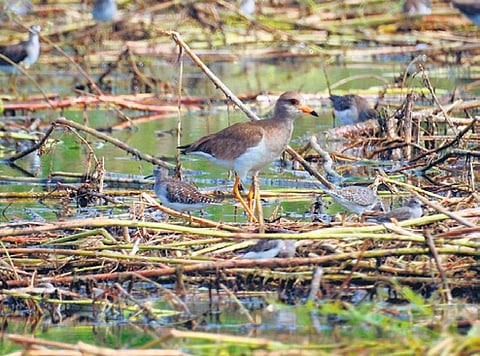
Amongst the reeds and sandpipers, something moved. It had gangly, yellow legs, and a pert yellow beak tipped with black. It looked like someone had coloured a Red-wattled lapwing (a common bird with a shrieking ‘did he do it, did he do it’ call) in the wrong colours. It was, in fact, a Grey-headed lapwing.
This is a bird that breeds in China and Japan, and migrates to the Eastern coast in India. I have seen them in Odisha. To see an individual hundreds of kilometres away in Delhi could suggest two things. Firstly, the bird had been disturbed and had come to non-traditional areas for sustenance. Two: it was simply a bold individual which was pushing the boundaries of its comfort.
While we never know everything there is to know with wild birds, one often veers towards exceptionalism. One wants to believe the specimen we are looking at is intrepid and unique. As we delighted in our sighting, we also knew that migratory birds are besieged by various threats in their journey, warming Northern climes being one of them. The only solution for a country that is a sink for millions of migratory birds is to provide more wetlands, resting and staging sites for them, and to study birds to see how they are adapting to threats.
For that transitional September day, we didn’t know the Grey-headed lapwing’s story and why it made the choices it did. What remained was a feeling of wonder—how a bird wings it way through life, generation after generation, uncomplainingly.
Neha Sinha
Conservation biologist and author
Views expressed are personal
Posts on X: @nehaa_sinha
