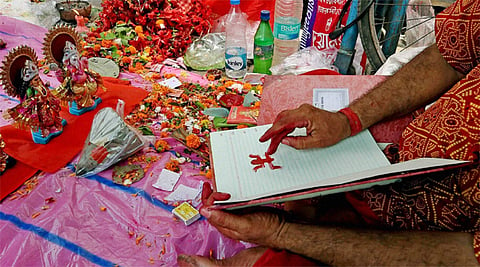

The early morning wake up call, Ma pulling me out of my lazy bed to take a quick shower even when the sun is yet to discard its blanket of the night sky and peep out of the eastern horizon. I struggle hard to keep my slumberous eyes from shutting down and drag myself with the excitement of getting into my new clothes while Ma would be busy making all the preparations to welcome this auspicious day- Poila Baisakh - the Bengali New Year.
As I take a detour down the memory lane and celebrate Poila Baisakh in my own little way now, memories of the good old childhood days flood in.
Poila Baisakh is the first day of the first month of the Bengali calendar, marking the beginning of a new year, which is usually celebrated on April 15. Poila Baisakh ushers in amidst joyous fervour, pomp and grandeur with families exchanging new clothes, sweets and pleasantries among relatives and friends.
Commencing at dawn, the Bengali New Year day is often interspersed with various cultural programmes ranging from singing, dancing, recitation, processions, and fairs. Traditionally, all business activities start this day with a new ledger.
I remember accompanying my dad to his shop where he used to perform puja invoking the Goddess of Wealth Lakshmi and the God of Prosperity Ganesha before starting his Haalkhata (new financial record book).
| View Gallery: Welcoming 'Poila Baisakh'- The Bengali New Year |
Women would draw beautiful alpanas (rangolis) in front of the house with rice flour, adorn its centre with an earthen pot decorated with auspicious ‘swastika’, filled with holy water and mango leaves to symbolise a prosperous year for the family.
Another vivid memory of Poila Baisakh that I cherish till date is the grand cultural fest organised by a local recitation school where my brother was a member of. I can recollect his childish voice reciting the many evergreen poems of Rabindranath Tagore as he confidently modulated his voice, clad in a brand new dhoti kurta, dazzling in the rays of the rising sun that glittered when reflected on the flowing water of the Hooghly river. An open ground facing the Hooghly river was the usual venue of this annual fest. As the morning breeze caressed my face, I would stand there mesmerized, drowning myself in the aura of this auspicious new year dawn.
The ‘sweet Pongal’ that I tasted yesterday on the occasion of ‘Puthandu’ (Tamil New Year) just reminded me of the many traditional Bengali delicacies that Ma used to prepare on Poila Baisakh. Be it the hot steaming rice with a dab of ghee, echorer dalna (raw jackfruit curry), doi ilish (Hilsa fish prepared with curd), macher kalia (fish curry) to kacha aamer chutney (raw mango chutney) to payesh (milk and rice pudding), the lunch would be a gala feast for all foodies. Not to miss, the array of sweets that adorned the dessert menu- rasagollas, sandhesh, ras malai and many more.
Tracing back history, the development of the Bengali calendar is often attributed to king of Gour or Gauda, Shashanka as the starting date falls squarely within his reign. Mughal Emperor Jalaluddin Muhammad Akbar, introduced a revised Bengali Calendar in order to make tax collection easier in Bengal.
The celebrations of the New Year starts early from the last month of the departing year- Chaitra. The month is a bliss for frantic buyers and shoppers as clothing outlets organise a ‘Chaitra Sale’, luring customers with attractive discount offers. People also clean their houses prior to the new year celebrations. Prominent festivals that mark the Bengali year-end are 'Chaitra Sankranti' with exciting fairs and festivals like Gajan and Charak that is celebrated across West Bengal.
Panjika or the Bengali almanac is also associated with the Bengali new year. A fat yearlong handbook citing festival timings, favorable days, auspicious dates for wedding to housewarming, from starting a journey to launching a business, the Panjika is an inevitable part of every Bengali household, besides the Bengali new year calendar that one can find hanging on the wall of almost every room of the house.
As I travel in time and space, reminiscing the bygone days, I draw a scintillating image of Poila Boisakh celebrations back home, reliving the moments, leaving you with a piece of my memory of this wonderful Bengali New Year day.
‘Shubho Nabo Barsho’ (Happy New Year) to all!