
NEW DELHI: After eleven years, the ministry of overseas Indian affairs will cease to exist - as it returns to its original existence of being part of ministry of external affairs.
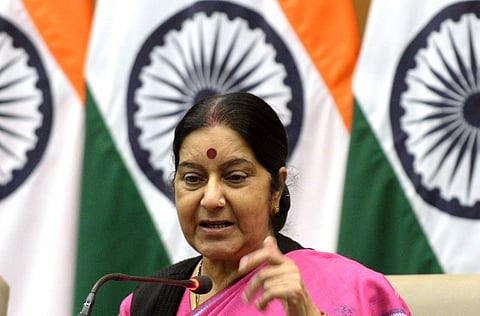
The announcement was made by Sushma Swaraj, who is minister of both MEA and MOIA, on Twitter.
"As Minister for External Affairs and Overseas Indian Affairs, I realised that substantial work of our MOIA is done through our missions abroad," she said.
Based on her assessment, Swaraj made a proposal for merger of MOIA with MEA.
"Hon'ble Prime Minister has kindly accepted my proposal. So MOIA will now be part of Ministry of External Affairs," she announced.
Later, the MEA spokesperson expounded that till the NDA-2 government had taken over, there had been two separate ministers in charge of both the ministries. Since May 2014, Sushma Swaraj and General VK Singh have been looking after both MEA and MOIA.
"It soon became apparent that more can be done to utilize the natural synergy between our fp objectiove and diaspore outreach and division between ministries was entirely unnatural resulting in duplication of work and uncessary delay," said Swarup.
As Swaraj had noted earlier, Swarup stated that "entire execution of decisions and policies taken by moia lay on posts and missions abroad which come under in juridiscion of MEA".
"Even Ministry of Overseas Indian Affairs responses on parliamentary questions had to rely on data provided by Indian missions abroad," he said.
Swarup added that Swaraj was "personally supervising" the administrative arrangements for the merger, so that current resources are optimised "and all needs of Indian diaspora are taken care of".
This decision was taken in Lin with the policy of "minimising government and maximising governance", he added.
Therefore, the Pravasi Bharatiya Divas celebrations will naturally come under the aegis of MEA from this year.
MOIA had begun in September 2004 after the NRI affairs division was carved off from external affairs ministry. Jagdish Tytler had been the first minister of state for overseas Indian affairs, before he had to resign over his role in the 1984 anti-Sikh riots.
Before he left, Tytler had lavishly renovated two floors in Akbar Bhawan in central Delhi, which had been the home of MOIA ever since. After Tytler, Vayalar Ravi had been the minister in both UPA-1 and UPA-2 governments.
Incidentally, MOIA never had a separate finance division and was entirely dependent on MEA for this expertise. In fact, this led to frequent friction with MOIA asking finance ministry several times for permission to create a separate finance division, as it felt that ministry's budget was being utilised for the objectives of MEA.
For example, MEA had dipped into MOIA's funds given to various Indian missions for distressed overseas Indians to fund the several big evacuation operations conducted in West Asia in 2014 and 2015.
