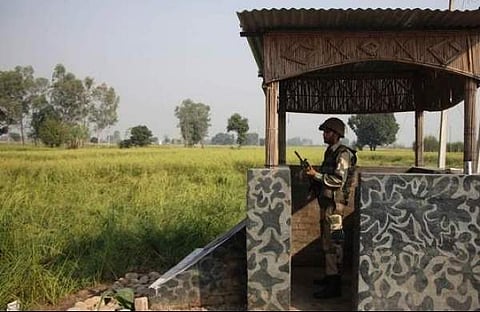

NEW DELHI: India’s defence establishment has urgently flagged that its secure communications were being interrupted by mobile telephone services that distorted messages in operational areas, a government source has told The Sunday Standard/The New Indian Express.
Ironically, the warning from the defence establishment comes just as time rolls into 2018 – from Monday – that will mark the centenary of the end of World War I when radio telephony was in its infancy. The consequences of garbled communication were illustrated by a young officer in that war.
The youth leading his soldiers under fire ordered his radioman to relay to his headquarters through a series of field telephones: “Send reinforcements, we are going to advance.”
What his superior received was this: “Send three and four pence, we are going to dance”.
A hundred years since that apocryphal story, India’s security forces have pointed to multiple reasons for a structured policy. Among the top reasons are the government’s own initiatives for a “Digital India” and “Smart Cities” that will demand increased bandwidth and spectrum.
In India, like in many other countries, the frequencies of electromagnetic waves through which radio signals are transmitted – collectively called spectrum – were vested with the defence forces. Allocation of the frequencies to private operators yielded easy revenues for the government and led to the 2G case that was dismissed by a court last week.
“This (interference in military communications) was always going to be an issue but it now seems to have proliferated,” explained Lt General Rajesh Pant (retired), former Additional Director General (Information Systems) at Army Headquarters, to The Sunday Standard.
Gen. Pant was one of the founders of the country’s Electronic Warfare (EW, in military parlance) and counter-EW programme.
“The proximity of (mobile) towers in some parts that can affect surveillance and reconnaissance and even jammers is a big concern,” he said.
Even if military communication is encrypted or coded interference puts the forces at risk if it can be tapped. And while the code may not be cracked, messages can be distorted – just like that of the officer 100 years back. The military wants its hardware and software to be upgraded. But that would be required tens of thousands of crores.
The first report of mobile phone signals affecting “tactical battle areas” – technical jargon for a distance of up to 30 or 40 kilometres from the Line of Control and the International Boundary (depending on the terrain) with Pakistan and the Line of Actual Control with China emerged four years back.
Before flashing an urgent requirement signal, the military sent a number of advisories to its own personnel. Among them were not to use mobile phones in operational areas and certainly not Chinese-made handsets. Last week, footage of soldiers stamping out mobile handsets of young recruits in a regimental centre went viral. The army officially justified it as an operational necessity.
“Digital media changes habits easily and you do not want distractions during operations,” said one officer. Across the military, as across industry, fresh recruits are or near being millennial – indeed all those who celebrate their 18th birthdays tomorrow (January 1) onwards would have been born in the year 2000.
But the military has also emphasized factors that include the changing nature of warfare and risks that are determining that change.
They have suggested that the “Defence Interest Zone” should be extended to parts of the country that are in the hinterland, away from borders, a background note circulated in the government has pointed out.
Not only is an armed conflict now of a “hybrid nature” but the army, navy and the air force are adapting to “network-centric warfare” for mobile operations. Therefore, the demand for spectrum within the military has increased, it has emphasised.
The presence and use of mobile operations in this environment is creating “Electro Magnetic Interference”, (EMI) says the note – jargon for distortions. To ensure “Electro Magnetic Compatibility” (EMC) of all defence equipment will be expensive. EMI is the disruption of electronic communication equipment by similar equipment. EMC is the ability of equipment to function as intended despite the disruption.
In one scenario illustrated by a former signals corps officer, a commanding officer near Uri should be able to tell the men leading patrols near the LoC to move in the direction intended and not elsewhere. In the taut situation of the LoC, where beheadings and mutilations of soldiers were reported even this month, 24 x 7 vigilance is the byword.
Apart from the army, the navy and the airforce are big users of multiple frequencies. All new navy vessels, including submarines such as the INS Kalvari that was commissioned by the Prime Minister this month, are within the ambit of NCO – Network Centric Operations. Cellular operations have also disrupted communications at air force bases.
Chart: Spectrum within the “Defence Band” as it used to be till about four years ago. Current status undisclosed:
1) 30MHz – 88 MHz. Also known as the technical-tactical band. Used by the military.
2) Other government users: Police, Doordarshan, ISRO
3) Uses: ground-to-air communications, surface-to-surface communications that were encrypted. The encrypted communication is now experiencing interference.
Approximate current scenario:
1) Cellulor radio (mobile phone operators in the 800MHz band (2G), 900MHz band (3G), 1800MHz band (4G).
2) Others in the ‘Citizen Band’. For example, users of walkie-talkie sets.
Information gleaned by The Sunday Standard.
