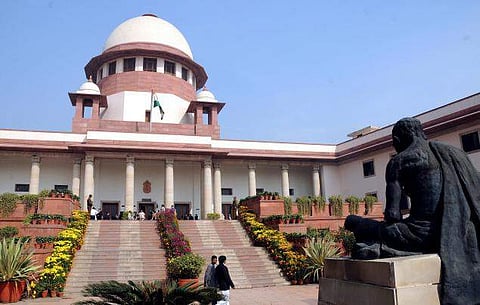

NEW DELHI: Coming to the rescue of a man who was asked to furnish 62 sureties for bail in 31 cases, the Supreme Court directed him to arrange for two people for walking out of jail.
A surety bond is a promise by a surety or guarantor for another party of a certain amount. If a second party fails to meet some obligation such as fulfilling the terms of a contract, the person who has taken the surety will be liable for it.
"There shall be two sureties who shall execute the bond for `30,000 which shall hold good for all the 31 cases. It is clarified that the personal bond so executed by the Petitioner and the bond so executed by the two sureties shall hold good for all the 31 cases," a bench headed by Justice R Banumathi said, modifying the Allahabad High Court order.
Hani Nishad, allegedly involved in 31 criminal cases in Lucknow district, was released on bail by the High Court in May and was directed to arrange two sureties each for all the cases. He approached the High Court seeking modification of the order but got no relief. Subsequently, Nishad reached the Supreme Court with his petition.
In his plea, Nishad pointed out that it was impossible for him to arrange 62 sureties and that despite getting bail, the onerous condition would not let him out. He cited another order by the High Court in a similar case where the accused was permitted to have common sureties for different cases.
Finding merit in Nishad's plea, the bench lent credence to the order issued by the High Court in a similar case and diluted the stringent condition. It allowed Nishad to produce only two sureties instead of 62 for enabling him to walk out of jail.
