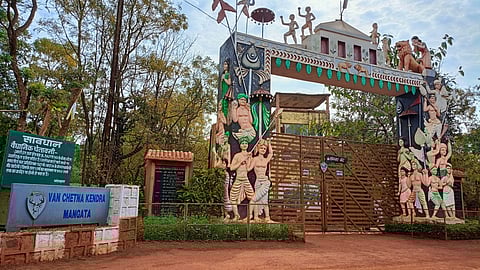

RAIPUR: The Chhattisgarh Forest Department mitigated the ecological challenges and effectively addressed human-wildlife conflicts by creating an Eco-Tourism Centre, ‘Van Chetna Kendra,’ as a sustainable model that now attracts visitors and wildlife enthusiasts from across the country and abroad.
The eco-tourism destination at Mangata in the Rajnandgaon Forest Division, about 100 km from Raipur, is seen as a singular concept conceptualised by the then Chief Minister Dr Raman Singh in the year 2015.
The undertaking also supports community well-being and forested socio-economic development in the region.
Mangata, a 387-hectare forest block, is uniquely bordered by stone quarries, with a national highway and a railway track (route) in its vicinity, adding to its ecological pressures.
The area is home to spotted deer, wild boars, hares, and various reptile species. Before 2015, the region experienced frequent human-wildlife confrontations, with wild animals damaging crops and causing discontent among farmers. The annual compensation that the forest department paid was Rs 10 to 15 lakhs. Water scarcity during summers led to accidental wildlife deaths.
Dev Lal Sahu, former Sarpanch of Mangata, said, “Frequent crop damage by wild animals caused resentment among farmers, prompting us to seek a lasting solution from the government.”
The Van Chetna Kendra ensured a balance between wildlife protection and the well-being of the local population with infrastructural development and by augmenting essential facilities, along with fencing the area.
“Besides addressing ecological concerns, the eco-tourism centre created a good scope for self-sufficiency by generating employment and encouraging entrepreneurship among local unemployed youths. The vision nurtured by the state government focuses on environmental sustainability and community development,” said V. Sreenivasa Rao (IFS), PCCF & HoFF.
Van Chetna Kendra introduced a range of facilities designed to attract visitors and nature lovers, and support wildlife. The site features accommodations such as tent houses, tree houses, stone houses, and mud houses, along with a children’s garden (Bal Udyan), an open theatre for environmental education, and a waterfall viewpoint.

With thousands of tourists arriving annually at Mangata, three well-planned trails have been developed to enhance visitors’ experiences. Solar-powered tube wells, a stop dam, and a reservoir have been constructed to ensure year-round water availability in the region.
“A little-known Mangata before 2015 is now attracting wildlife and nature enthusiasts from India and abroad. The move has improved local livelihoods, empowering youth and women even from the neighbouring villages. With around 150 resorts, the region witnesses good economic growth,” said Meera Sahu, Mangata Sarpanch.
With this success, the state forest department is considering replicating such an eco-tourism model across Chhattisgarh.