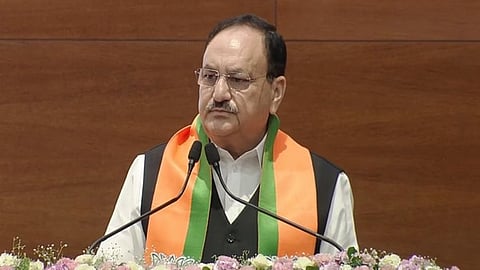

NEW DELHI: During the unprecedented COVID-19 pandemic, India emerged not only as a global leader in health resilience and innovation but also reaffirmed its role as the ‘Pharmacy of the World,’ said Union Health Minister JP Nadda on Monday.
While inaugurating the 19th International Conference of Drug Regulatory Authorities (ICDRA), he emphasized the shared commitment to enhancing global healthcare standards and safeguarding public health.
“India rapidly expanded its healthcare infrastructure and scaled up vaccine production to meet both domestic and global demands. The successful rollout of the COVID-19 vaccination program, covering over a billion people, is a testament to the robustness of our healthcare system, the dedication of our health workers, and the soundness of our policies,” he said.
He highlighted that India played a crucial role in ensuring affordable access to essential medicines, vaccines, and medical supplies for nations across the globe.
“Guided by the principle of ‘VasudhaivaKutumbakam’ – the world is one family, we extended our support to more than 150 countries, providing life-saving drugs and vaccines during the pandemic,” he said at the five-day event hosted for the first time in India, organized by the Central Drugs Standard Control Organization (CDSCO), Union Health Ministry, in collaboration with the World Health Organisation (WHO), and which brought together regulatory authorities, policymakers, and health officials from over 194 WHO member states.
“This spirit of international solidarity is at the heart of India’s approach to global health. We believe that our progress is inseparable from the progress of the world, and as such, we remain committed to contributing to global health security and sustainability,” he said.
He also said that more than 95% of regulatory processes currently have been digitised at CDSCO, bringing transparency and increasing trust among stakeholders.
“The ICDRA platform provides a space to share knowledge, foster partnerships, and develop regulatory frameworks that ensure the safety, efficacy, and quality of medical products worldwide.”
Highlighting the achievements of CDSCO, Nadda said that “it has developed robust systems for approving safe and efficacious drugs and medical devices in the country and for export to more than 200 countries in the world.”
Availability of quality medicine at affordable price is at the core, he said, and added that eight drug testing labs are operational currently while two more are in the pipeline.
Eight mini-testing labs are operational at different ports for quick testing and release of drugs and raw materials being imported. In addition, he said, 38 State Drug Regulator’s Testing Labs are operational. “Altogether, more than a hundred thousand samples are being tested every year under regulatory surveillance mechanisms.”
“Considering the importance of medical devices in health care delivery, the Medical Device industry in India is also being regulated. Drugs Rules have been amended to make Good Manufacturing Practice Guidelines more comprehensive and at par with the WHO-GMP guidelines,” the minister said.
He said in order to make the drug supply chain robust, it has been made mandatory to provide a Bar Code or Quick Response Code (QR Code) on top 300 brands of drug products. Similarly, QR Code is mandatory on all API packs, either being imported or manufactured in India.
“We believe in 3 Ss i.e. “Skill, Speed and Scale” and by focusing on these three aspects, we have been able to meet the increasing demand for pharma products while adhering to global quality standards without any compromise. We are prepared to address pressing challenges, from antimicrobial resistance to ensuring equitable access to life-saving treatments. We are not just participants in this dialogue; we are partners in building a healthier, safer and more resilient world,” he said.
Dr Tedros Adhanom Ghebreyesus, Director-General of WHO, in his virtual address, commended India for hosting the crucial global regulatory forum and highlighted the importance of global cooperation in drug regulation, particularly in light of challenges such as antimicrobial resistance, the post-pandemic world, and the safe use of AI in healthcare.
Dr SaimaWazed, Regional Director, of WHO Southeast Asia Region said, “India is the largest provider of generic medicines while the Indian Pharmaceutical Industry is the third largest in the world.”
She noted that India provides over 50% of the world’s vaccine demands.
Emphasising that a strong regulatory system is crucial to achieving universal health coverage, she highlighted the need for strengthened regulatory convergence and information sharing between national regulatory authorities.
Union Health Secretary Punya Salila Srivastava said that the Indian pharmaceutical industry has recently become the fourth largest export sector of India, exemplifying the level of integration into the global pharmaceutical supply chain.
“India is the third largest producer of pharmaceuticals in the world, and has the largest number of US FDA-approved plants outside the USA. India supplies 50% of the world’s vaccines, most of them going to UN agencies like WHO, UNICEF and the Pan American Health Organization (PAHO) and to organisations like GAVI, " she said.
Dr. Rajeev Singh Raghuvanshi, Drugs Controller General of India (CDSCO) highlighted India’s achievements in the drugs control and medical devices sector, including the approval of India’s first CAR T-cell therapy. “We are continuously upgrading our skills and capacities in our systems and are on a path towards low regulation and high execution,” he said.