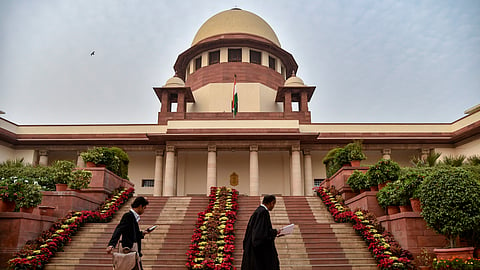

NEW DELHI: In a significant development, the Supreme Court has agreed to hear in open court a plea filed by the National Highways Authority of India (NHAI) seeking a review of its earlier verdict that ruled the apex court’s 2019 decision on granting compensation with interest to farmers, whose land was acquired under the NHAI Act, would apply retrospectively.
A bench of Justices Surya Kant and Ujjal Bhuyan issued notice on the review petition and listed the matter for an open court hearing on November 11.
Solicitor General Tushar Mehta, appearing for the NHAI, recently informed the bench that the matter would have “wide implications of around ₹32,000 crore and not ₹100 crore as was stated earlier in the petition.”
“Issue notice, returnable on November 11, 2025, at 3 PM,” the bench ordered on Tuesday.
On February 4, the top court, while rejecting NHAI’s plea, had ruled that its 2019 decision allowing the grant of compensation and interest to farmers whose land was acquired under the NHAI Act would apply retrospectively.
The NHAI had sought that the applicability of its 19 September 2019 judgment be made prospective, thereby precluding the reopening of cases where land acquisition proceedings had already been completed and the determination of compensation had attained finality.
The bench, however, had said, “We find no merit in the contentions raised by the applicant, NHAI. We reaffirm the principles established in Tarsem Singh (2019 decision) regarding the beneficial nature of granting ‘solatium’ and ‘interest’ while emphasising the need to avoid creating unjust classifications lacking intelligible differentia. Consequently, we deem it appropriate to dismiss the present miscellaneous application.”
The court had further held that in its 2019 decision, Section 3J of the NHAI Act—by excluding the applicability of the Land Acquisition Act of 1894 and thereby denying solatium and interest for lands acquired under the NHAI Act—was violative of Article 14 of the Constitution.
“Regardless, the prayer in the instant application expressly seeks clarification that the decision in Tarsem Singh should be deemed to operate prospectively only. However, in our considered view, granting such a clarification would effectively nullify the very relief that Tarsem Singh intended to provide, as the prospective operation of it would restore the state of affairs to the same position as it was before the decision was rendered,” the bench had said in February.
Referring to the 2019 decision, which held Section 3J of the NHAI Act unconstitutional, the apex court had said the broader purpose behind the Tarsem Singh verdict was to resolve and put a quietus upon the quagmire created by Section 3J of the NHAI Act, which led to the unequal treatment of similarly situated persons.
“The impact of Section 3J was short-lived, owing to the applicability of the 2013 Act upon the NHAI Act from January 1, 2015. As a result, two classes of landowners emerged, devoid of any intelligible differentia: those whose lands were acquired by the NHAI between 1997 and 2015, and those whose lands were acquired otherwise,” it had said.
It had further observed that the 2019 verdict must be viewed in light of the principle that when a provision is declared unconstitutional, any continued disparity strikes at the core of Article 14 of the Constitution and must be rectified, particularly when such disparity affects only a select group.
Illustrating this, the bench had said, “If the 2019 decision was rendered as prospective, then it would create a situation where a landowner whose land was acquired on December 31, 2014 would be denied the benefit of solatium and interest, whereas a landowner whose land was acquired the very next day, January 1, 2015 — the date on which the ordinance was promulgated — would be entitled to these statutory benefits.”
The court added, “That being so, the decision in Tarsem Singh also cannot be assailed on the grounds that it opens a Pandora’s box or contravenes the doctrine of immutability, as it merely allows for the grant of ‘solatium’ or ‘interest’, which are inherently embedded as compensatory benefits under an expropriating legislation. This exercise cannot be equated to reopening of cases or revisiting the decisions that have already attained finality.”
The top court had clarified that the ultimate outcome of its 2019 decision was limited to granting solatium and interest to the aggrieved landowners whose lands were acquired by NHAI between 1997 and 2015, and it did not, in any manner, direct the reopening of cases that had already attained finality.
