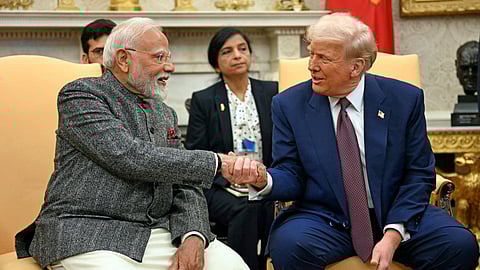

Relationships are complex. They begin with a honeymoon period where everything seems rosy, and then reality sets in. Nations are no different, but might take a bit longer to get there. In this case, a few years.
As President Trump and Prime Minister Modi reiterate that their friendship is evergreen and long-lasting, the credibility built slowly by previous US Presidents, including Donald Trump as the 45th President of the US, has eroded.
For India, siding with Pakistan has always been the US’s cardinal sin. A sin it has repeatedly committed despite the terrorism that the country has exported into India and the rest of the world.
But what the US has learned is that there is a far greater sin that is unacceptable to most Indians. And by extension, to any politician, even one as popular as Prime Minister Modi who has been the closest to the US during his long tenure. The long history of invasions, colonialism, and cruel governance by foreign powers has developed a hardline national instinct. While India’s leaders and her people can be swayed and influenced, the country will not accept being dictated to by a foreign power. The primacy of the state is paramount for India.
International Relations theorist Morgenthau understood this truth decades ago. No state wants to be in the power of another. The only way to make power acceptable is by masking it by building institutions (United Nations, NATO, QUAD) and the promise of mutual benefit.
India showing a willingness to drop tariffs from certain sectors held out that promise. It was a move that was celebrated by large tracts of Indian people who want to purchase US goods. It was also a victory for US businesses. Unfortunately, President Trump wanted more. Concessions were not enough, he wanted submission.
The US policy shift from persuasion through mutual benefit to bribes and threats is eerily reminiscent of what Thucydides warned in the History of the Peloponnesian War (4 BCE), which recounts the war between Sparta and Athens. He suggested that as demagogues rose to power and pursued foreign policies at odds with the city-states that they held an influence over, Athens lost its status as a respected leader. From a hegemon, it became an archē -- used to describe a political unit that sought influence through threats and bribes. For the US, it means other nations seeing America First and Others Last.
For Thucydides, like Morgenthau, successful leadership rests on persuasion and is limited to policies that are welcomed and supported by others in their interest. Over time, this cooperation becomes a habit, and the hegemon can exercise its leadership freely.
But Washington instead pressed too hard. It nudged India back into cautious talks with China, a move that will delight Russia. A genuine partnership may be a step too far, but the message here is clear: India will not be boxed into a corner.
Of the three premier powers that attended the recent SCO summit, Russia is directly antagonistic to the US and Europe with war in Ukraine. China is competing with the US and seeks to establish, at the very least, a bipolar world order. India is the only power whose national interests donot conflict with the US. Instead, its interests are far more competitive with China. Yet, India is opening up its options, showing that it can work with China when necessary. It is entirely on the US and the Western Bloc, intent on a China plus 1 policy, to persuade India back to their corner seems to be the messaging.
And well, who can quarrel with that? it is integral for US interests to have India as a dependable ally. The world’s largest democracy is an extension of the idea that US and its western allies built post-World War II.
All this comes at a time when the idea of liberal institutionalism and democracy as the premier system for a better life is being challenged by the reality that an authoritarian government is building and competing with western standards of living. China has maintained its internal structure of governance, while competing with the West in technology and living standards.
The challenge that China poses is compounded by the failure of the US-led financial system to deliver a large enough impact on the Russian economy to halt its steady expansion into Ukraine.
The US had foreseen Asia as the next stage to ensure their primacy. Growing economies and populations, along with diminishing returns and largely set relations in Europe and the Middle East triggered President Barack Obama’s 'Pivot to Asia'. It was meant to be a realignment of US interests to prepare Washington for this very contest. But a decade since, the US is still pivoting.