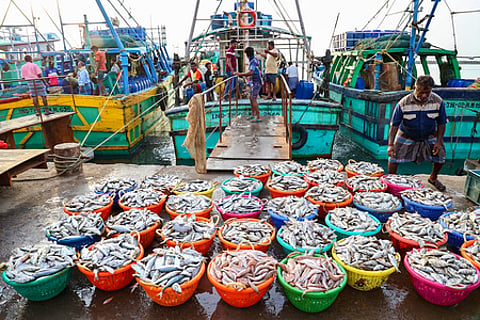

NEW DELHI: India’s seafood exports have surged in volume but weakened in value, caused by a dip in the rate of the seafood internationally. Data placed in the Lok Sabha on April 2, 2026, by the Ministry of Food Processing Industries in reply to a question by Tangella Uday Srinivas (MP, Kakinada) shows exports rising from about 11.5 lakh metric tonnes in 2020–21 to nearly 17.8 lakh metric tonnes in 2023–24, before a slight dip. Export earnings crossed $8 billion at their peak, yet unit prices fell sharply from $5.67 per kg to about $4.14–4.39 per kg, indicating that higher shipments are fetching lower returns.
This divergence comes amid turbulence in India’s key export market. The United States, which accounts for roughly a third of India’s seafood exports, imposed tariffs of up to 50% in 2025, sharply raising costs and eroding competitiveness. Shipments to the US dropped steeply in the latter half of the year, with some months seeing declines of over 50% year-on-year as buyers shifted to lower-tariff suppliers such as Ecuador. The tariff shock split the export cycle. Volumes held up earlier in the 2025, but prices and orders weakened later as supply chains adjusted. Exporters were forced to cut prices to retain market share, contributing to the fall in unit value even as aggregate quantities remained high.

Industry estimates suggest seafood exports could fall by around 20% in adverse conditions, with some shipments to the US projected to decline sharply due to tariff burdens.
The tariffs were partially eased to around 18% in early 2026, offering some relief, though the gap with competing countries remains. At home, processing capacity continues to expand. India now has 671 marine fish processing units, with Gujarat and Andhra Pradesh leading, followed by Kerala. These states form the sector’s industrial base, while eastern states such as West Bengal and Odisha lag behind.
Government support is channelled through schemes such as the Pradhan Mantri Kisan Sampada Yojana and Production Linked Incentive Scheme for Food Processing Industry. Together, they have supported projects worth over Rs 1,800 crore, focusing on cold chains, mechanisation, and value addition. Despite this push, the sector remains tied to bulk exports. The fall in unit prices suggests limited movement up the value chain.