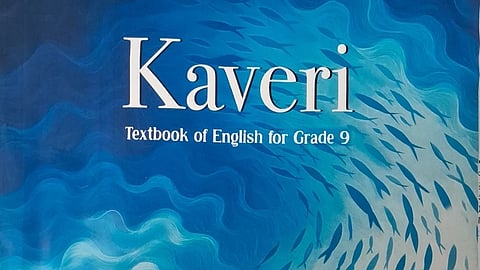

NEW DELHI: The newly released National Council for Educational Research and Training (NCERT) English textbook for Class 9 places a strong emphasis on promoting Indian languages through English, in line with the National Education Policy (NEP) 2020. Titled Kaveri, the book, which was ready as early as January, has now reached the market.
Amid the recent language controversy involving the Union Education Minister and the Tamil Nadu Chief Minister, the textbook makes an ambitious push to promote multilingualism and cultural rootedness among students.
A senior NCERT official told this reporter, "The thrust is on promoting Indianness. A frequent feedback we received from teachers was that the students found it difficult to relate to the context in the lessons. This has been redressed here. Right from the name 'Kaveri', metaphorically used to convey 'River of Knowledge', students will be able to relate to the content throughout."
The attempt at promoting multilingualism is evident from the opening chapter, extracted from Padma Bhushan and Padma Shri awardee Sudha Murthy’s book How I Taught My Grandmother to Read and Other Stories.
While it explains that ‘Avva’ means mother in Kannada spoken in North Karnataka, the competency exercise at the end of the chapter highlights that India has 22 major languages under the Eighth Schedule of the Constitution.
Students are asked to list words such as grandmother, grandfather, mother, father, sister and brother in any five Indian languages by interacting with classmates or teachers.
The chapter titled Winds of Change, accompanied by pictures of hand fans (pankha) from different states, asks: “Does anyone in your family use a hand fan? What do you call it in your language?”
The textbook includes creative pieces from established authors and poets. These include the poem Bharat Our Land by Tamil poet Subramania Bharati, Nobel laureate Rabindranath Tagore’s I Cannot Remember My Mother, Vitamin-M by Asha Nehemiah, and The Lost Child by Mulk Raj Anand. Chapter 7 focuses on words and their usage, while grammar is taught in an engaging manner.
"While the content in each chapter is only for a few pages, the competency exercises sometimes run up to 20 pages for each chapter. The objective is to develop key learning skills," the official pointed out.
Inspiration for students is provided through the chapter The World of Limitless Possibilities, which showcases real-life Paralympic achievers, including para-archer Sheetal Devi.
The achievements of Paralympian Deepa Malik are highlighted in an interview format, bringing out the dedication and resilience of the 2016 Rio Paralympic Games awardee and the first Indian female para-athlete to win an Asian Games medal in the shot put event.
Another official said, “This specific chapter will not only inspire children but also motivate paralympic athletes when they realise they are being showcased as role models for the next generation.”
The book also offers insights into traditional crafts across states. The section Learning Beyond the Text features pottery traditions such as Khurja from Uttar Pradesh, blue pottery from Jaipur, terracotta from West Bengal, Andretta from Himachal Pradesh, Karigati from Tamil Nadu and Longpi Black from Manipur.
The theme of inspiration continues with a chapter titled Follow That Dream. The 276-page book concludes with Dorothy Hewett’s poem Believe in Yourself.
However, the extensive use of visual imagery throughout the book has raised some concerns about its suitability for senior-grade students. Responding to this, the official said, "Our books are used extensively in government schools. It has been done consciously. We do not want the matter to look boring and text-heavy."
The book is priced at Rs 140 and is available at NCERT offices, bookstores across the country and on Amazon. Language textbooks in Hindi, Urdu and Sanskrit are also set to be made available from today.
