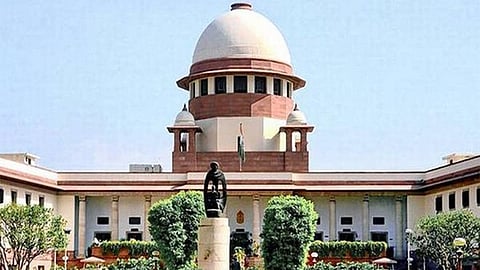

NEW DELHI: The Supreme Court on Friday held that the State cannot differentiate between serving employees and pensioners when enhancing allowances meant to counter inflation.
In a significant judgment upholding the right to equality for retirees, a bench comprising Justice Manoj Misra and Justice Prasanna B Varale dismissed appeals filed by the State of Kerala and the Kerala State Road Transport Corporation (KSRTC) and affirmed that inflation hits both serving and retired employees with "equal force".
“Equality is a dynamic concept with many aspects and dimensions, and it cannot be cribbed, cabined and confined within traditional and doctrinaire limits. From a positivistic point of view, equality is antithetic to arbitrariness. In fact, equality and arbitrariness are sworn enemies; one belongs to the rule of law in a republic while the other, to the whim and caprice of an absolute monarch,” Justice Mishra, who authored the judgement, said.
Referring to Article 14 (right to equality) of the Constitution, the verdict said it forbids class legislation but permits reasonable classification which must satisfy twin tests.
As per the twin tests, the classification must be founded on an intelligible differentia that distinguishes those that are grouped together from others, and second “that differentia must have rational nexus with the object sought to be achieved by the Act”, it added.
The bench said the judgments cited by KSRTC do not deal with a situation where there is no dispute as regards entitlement to the benefit in question.
“Here, the retired employees are not only entitled to pension but also dearness relief, which is revisable from time to time, based on inflation. Thus, the issue is not of entitlement to the benefit but of differential rates at which those benefits are provided, dependent on whether the recipient is a serving or a retired employee,” it said.
“When those benefits serve a common purpose and are linked to inflation, and inflationary pressures do not discriminate between a serving employee and a pensioner, fixing different rates of enhancement of dearness allowance and dearness relief have no rational nexus to the object sought to be achieved and is clearly discriminatory as well as arbitrary,” the bench said.
It said no doubt, financial crunch might be a guiding factor to defer disbursement of certain benefits or may justify separate dates for implementation of beneficial schemes.
“But once a decision is taken to provide certain allowances as also to increase them, based on inflation, fixing a higher rate of increase for the ones who are serving than the ones who have retired, would be arbitrary and violative of Article 14…,” it said.
The case originated from a 2021 Government Order by the Kerala government. To meet inflationary pressures, the government sanctioned an enhancement of Dearness Allowance (DA) for KSRTC employees by 14 per cent while limiting the Dearness Relief (DR) for pensioners to only 11 per cent.
Retired employees challenged this discrepancy in the Kerala High Court.
While a single-judge bench originally dismissed their plea, a division bench later ruled in favour of the pensioners, prompting the state and KSRTC to move the Supreme Court.