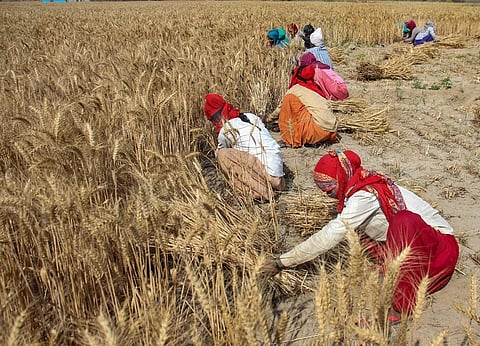

NEW DELHI: After experiencing warmer weather in February and March, wheat crop is now facing excessive rainfall in the first 10 days of April, raising concerns about potential negative impacts on overall production. However, the government has sets aside the apprehension, claiming that the country will witness more wheat production than before.
During a visit to the Institute of Wheat and Barley Research (IIWBR) in Karnal to assess wheat crop production and research, Dr M L Jat, the Director General of the Indian Council for Agricultural Research (ICAR), said in an interaction with this newspaper that mild rain at this stage is beneficial for wheat crops and that the country is expected to achieve record production.
Excess unseasonal rainfall accompanied by wind lashed different parts of major wheat-producing states like Uttar Pradesh, Madhya Pradesh, Punjab, Haryana, Rajasthan, Bihar and Gujarat, causing flattening of the standing wheat crop in some pockets.
This year, India’s wheat acreage has increased to 33.4 million hectares (mha), compared to 32.58 mha in 2025. The increase in acreage will give India another year of bumper production. Last year, India recorded a total wheat production of 117.9 million metric tones (mmt).
India has harvested 40% of its total wheat, and the rest, which would start harvesting from mid-April, is in the Indo-Gangetic plains. However, these regions have experienced excess rainfall in the past 10 days.

“Wheat crop production and quality are more susceptible to terminal heat and hailstorms, which we have so far not experienced, so our production will be bumper, which can go up to 119.4 mmt,” claimed Jat, who was on a visit to Karnal.
Dr Ratan Tiwari, IIWBR Director, explains that the wheat region experienced above-normal temperatures in February and early March, followed by normal to below-normal temperatures. “The phase of terminal heat, which could have negatively impacted the wheat, had gone, and the light rainfall would only help late sowing crops. There are around 7-8% late sowing crops in the country,” said Tiwari.
The only disadvantage to the wheat crop is the phase of terminal heat, which has already passed. India has already been allowed to export 2.5 mmt of wheat this year. Besides, the government has invested heavily in climate-resilient varieties, including those for abiotic and biotic stresses.
Jat said that India has invested in the biofortification of wheat. “Currently, India has 40% of biofortified wheat of the total areas which are rich in zinc and proteins, helping India in countering malnutrition,” said Jat.
He further informed that the ICAR has also started the Biological Nitrification Inhibition (BNI) project in collaboration with the Japanese government, which will develop a wheat variety that consumes up to 25% lesser urea. While acknowledging the significant progress achieved under the BNI-Wheat initiative, Dr Jat highlighted opportunities to further expand the research scope and impact of the project.