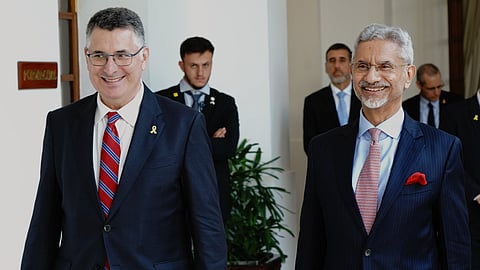

NEW DELHI: Israel briefed India on the rapidly evolving West Asia situation and the collapse of US--Iran talks during a phone conversation between Israeli Foreign Minister Gideon Saar and External Affairs Minister S Jaishankar on Tuesday, as regional tensions continue to escalate.
The outreach comes in the wake of failed high-stakes negotiations between Washington and Tehran in Islamabad, which ended without a breakthrough after prolonged discussions, leaving key disagreements over Iran’s nuclear programme unresolved.
Detailing the conversation, Saar said he discussed the broader geopolitical situation with Jaishankar, including Iran, the Strait of Hormuz and Lebanon. “A good conversation, as always, with my friend, India’s Minister of External Affairs,” he said. Saar then went on to emphasis on the importance of a firm US position in ongoing nuclear negotiations with Iran. “I said that the firm American stance in the negotiations on conditions that would prevent Iran from obtaining nuclear weapons (no enrichment in Iran, removal of enriched material from Iran) is critical for the entire international community,” he said.
He also raised concerns over maritime security, warning of broader economic implications.
“I also said that Iran's harm to freedom of navigation and the global economy through economic terrorism in the Strait of Hormuz requires action that will ensure the freedom of navigation for all countries, including India and our friends in the Gulf,” Saar added. The Strait of Hormuz remains a key flashpoint, given its role as a vital global energy corridor. Any disruption in the region has direct implications for energy markets and trade flows, making it a central concern for countries like India that rely heavily on Gulf supplies.
External Affairs Minister S Jaishankar on Tuesday also discussed the evolving security situation in West Asia during a phone conversation with Australian Foreign Minister Penny Wong, as diplomatic engagements intensify amid rising regional tensions. In a post on X, Jaishankar said the two leaders exchanged views on the conflict in West Asia and its wider implications for global stability and maritime security. “Appreciated the exchange of views today with @SenatorWong of Australia,” he said.
The conversation comes at a time when India has stepped up diplomatic outreach with key partners in the Indo-Pacific and Gulf regions, as developments in West Asia continue to raise concerns over energy flows and regional stability. Both India and Australia have been closely tracking the impact of the ongoing conflict on trade routes and the security of the Strait of Hormuz, a critical chokepoint for global energy supplies.
Jaishankar has also stepped up diplomatic outreach with key regional partners. On Monday, he spoke with Kuwaiti Foreign Minister Sheikh Jarrah Jaber Al-Ahmad Al-Sabah, focusing on the evolving regional situation and the welfare of the Indian community. “It focused on the regional situation and the well-being of the Indian community,” Jaishankar said after the talks.
