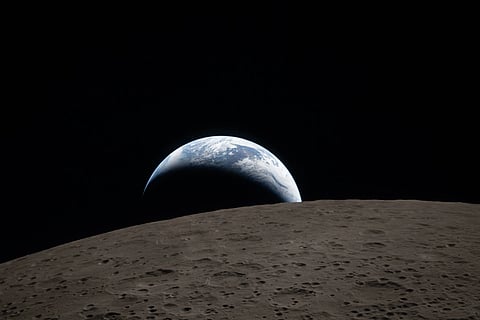

NEW DELHI: The success of Artemis II gives a lot of confidence to India, as the country's upcoming Gaganyaan mission plans to demonstrate the same capabilities that the recent spaceflight did, said Somak Raychaudhury, vice-chancellor and professor of physics at the Ashoka University.
The Artemis II crew splashed down in the Pacific Ocean, off the coast of California, on April 11 after completing a historic 10-day journey around the Moon.
This was the first time in more than 50 years that humans ventured into lunar vicinity.
"The flawless flight of Artemis II is fantastic news for Indians because the Gaganyaan mission will soon happen. It will do the same things that Artemis II did," Raychaudhury, one of India's best-known astrophysicists, said.
"The ISRO (Indian Space Research Organisation) has been working with the NASA (National Aeronautics and Space Administration) on Artemis for a long time and our astronauts are going through the same training programmes," he added.
The Gaganyaan mission, which will be India's first human spaceflight, is expected to be launched in 2027.
The Artemis programme's first mission was an uncrewed spacecraft that went around the Moon and came back in 2022.
The second mission is essentially a precursor for the actual Moon-landing mission in 2028.
The programme marks the beginning of a new era in human spaceflight that aims to create a permanent settlement on the Moon and frequent travels by humans to the lunar surface.
"Unlike the Apollo missions of the 1960s and 1970s, which were predominantly about the space race and Moon landings, the new missions are about ensuring a longer stay on the lunar surface," Raychaudhury said.
Having a sustained human stay on the Moon would help in carrying out much longer space missions, such as landing on Mars and asteroids.
"This will require a solid base on the Moon and the need to produce oxygen and water there. There will also be a requirement to generate energy to power computers and other equipment, and big activities such as mining," Raychaudhury said.
That is why scientists are hunting for frozen ice and helium-3 on the lunar surface, he added.
While frozen ice can be used for long-term purposes, including generating energy, helium-3 can provide nuclear energy.
Another benefit of helium-3 is that it generates a low amount of nuclear waste, which would be tough to get rid of in space.
However, building a permanent facility on the Moon will not be easy.
It will require several Moon missions, which will have to carry humans, robots, equipment and fuel on the lunar surface.
Even ensuring a workable toilet will be a challenge -- the toilet of Artemis II's Orian spacecraft, which housed the four astronauts, suffered at least two major failures during the mission.
"Underneath a space toilet, there is not only an elaborate vacuum system to suck everything that goes into the toilet but also a recycling plant which purifies urine. It is then used for drinking purposes. There are numerous components in the toilet which can break down," Raychaudhury said.
The success of Artemis II is just the first step towards building a base on the Moon, he added.
