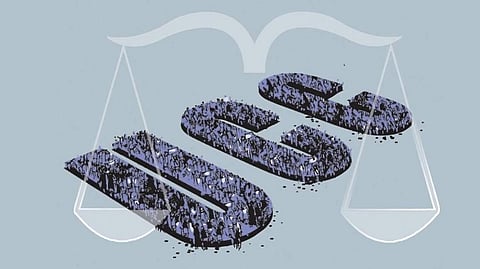

The Chhattisgarh cabinet on Wednesday decided to set up a high-level committee, headed by a retired judge, to prepare a draft for implementing the Uniform Civil Code in the state.
The government said the move is aimed at simplifying laws and promoting religious and gender equality.
According to an official statement, the need for a UCC was felt because “the existence of multiple personal laws creates inequality in legal processes and makes the justice system more complex”.
The decision was taken during a cabinet meeting chaired by Chief Minister Vishnu Deo Sai at Mantralaya Mahanadi Bhawan in Nava Raipur Atal Nagar.
The opposition Indian National Congress criticised the move, calling it a threat to tribal rights, and said tribal communities would be the worst affected.
The panel will be headed by retired Supreme Court judge Ranjana Prakash Desai, while the chief minister has been authorised to nominate the members of the committee, the statement said.
At present, matters such as marriage, divorce, inheritance, adoption, maintenance and family disputes in Chhattisgarh are governed by different personal laws based on religion. The Article 44 of the Constitution directs the state to work towards implementing a Uniform Civil Code for all citizens, it added.
The existence of multiple personal laws creates inequality in legal processes and makes the justice system more complex. The proposed UCC is aimed at simplifying laws to promote religious and gender equality, it said.
The committee will seek suggestions from citizens, organisations and experts, and may also invite feedback through a web portal. Based on its recommendations, a draft will be prepared and placed before the cabinet for approval, after which it will be introduced in the state assembly to establish a uniform and transparent civil legal framework, it added.
Sai said the state cabinet has decided to constitute a committee headed by retired Supreme Court judge Ranjana Desai to prepare a draft for the implementation of the UCC.
Talking to reporters here, the CM said the panel will consult all sections of society and senior representatives of various organisations before preparing a framework on how the UCC can be implemented in the state.
Opposition Congress, however, criticised the move, alleging that the ruling BJP is attempting to undermine the rights of tribal communities.
State Congress president Deepak Baij said the decision goes against the interests of tribals, who constitute over 32 per cent of the state's population and enjoy special constitutional protections.
"If the UCC is implemented in Chhattisgarh, tribals will suffer the most. It is against their interests," he said.
Baij, who hails from tribal community, pointed out that tribal communities in the state are protected under provisions such as the Fifth Schedule of the Constitution and the PESA (Panchayats (Extension to Scheduled Areas)) Act, which safeguard their land and governance rights.
He questioned whether these protections would remain intact if the UCC is enforced.
He also raised concerns about the rights of particularly vulnerable tribal groups, such as Baiga, Kamar, Pahadi Korwa, Birhor, Abujhmadia, Bhunjia and Pando, asking whether their constitutional safeguards would be preserved under a uniform law.
Baij claimed that after the decline of Naxalism in Bastar, industrial interests are eyeing tribal lands, and the push for UCC is linked to attempts to dilute tribal land rights.
"The BJP is conspiring to weaken the fundamental rights of tribals by bringing in the UCC. Any attempt to tamper with constitutional protections will not be tolerated," he said.
The BJP government in Uttarakhand formally implemented the UCC in January 2025, becoming the first state in the country to do so. The Gujarat assembly last month passed the UCC Bill, 2026.
(With inputs from PTI)
