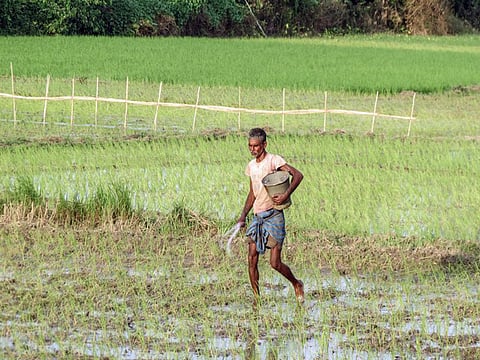

India’s agriculture sector may face a difficult year ahead due to concerns over a weak monsoon, the possible emergence of El Niño conditions, and risks to fertilizer supply stemming from the ongoing West Asia conflict, according to a report by ICRA.
The India Meteorological Department (IMD) has issued its first long-range forecast for the 2026 Southwest Monsoon, projecting rainfall at 92% (±5%) of the Long Period Average (LPA). This signals a likely below-normal monsoon. ICRA noted that the midpoint estimate is the lowest first forecast issued in at least 25 years, compared with a historical range of 93%–106% of LPA. This also marks a reversal from 2024 and 2025, when rainfall was above normal at 108% of LPA.
Below-average rainfall could adversely impact the sowing of kharif crops, which depend heavily on monsoon rains between June and September. “Sub-par rainfall is expected to weigh on sowing of kharif crops, and consequently, agricultural output, farm cash flows and food prices,” ICRA said. It added that weak rainfall may also hinder reservoir replenishment, as water levels typically decline ahead of the monsoon and recover during the season.
Global weather agencies have also indicated a 62% likelihood of El Niño conditions developing between June and August 2026. Such conditions are typically linked to weaker monsoon rainfall in India. “Regardless of intensity level, the materialisation of El Niño could weigh on the Southwest Monsoon season in India, posing risks to crop yields and output,” the report noted.
Fertilizer availability for the upcoming kharif season is another area of concern. The ongoing conflict in West Asia could disrupt supply chains for both raw materials and finished products, potentially affecting domestic production and necessitating alternative sourcing to meet demand.
ICRA has flagged downside risks to its FY2027 agriculture Gross Value Added (GVA) growth forecast of 3.0%. It also expects consumer price inflation (CPI) to remain above 4.5%, driven by potential food price pressures. While rural demand may stay supported in the first quarter of FY2027 due to rabi harvest-related cash flows, the outlook beyond that will depend heavily on monsoon performance.
However, higher reservoir levels provide some buffer. As of April 2, 2026, all-India reservoir storage stood at 47% of live capacity, compared to 40% a year ago and a 10-year average of 37%. ICRA noted that this offers partial relief against a weak monsoon, with most regions showing above-average storage except parts of eastern and southern India.
The report also emphasized that reasonable increases in minimum support prices (MSPs) for kharif crops will be key to sustaining farm sentiment. It added that even a below-normal monsoon could have limited impact if rainfall is well distributed across regions and time periods.
ICRA cautioned that a combination of weak rainfall, El Niño conditions, and fertilizer supply disruptions could pose significant risks to agricultural output, food inflation, and rural demand in FY2027. The overall impact will ultimately depend on monsoon behavior and geopolitical developments in the months ahead.
(With inputs from ANI)
