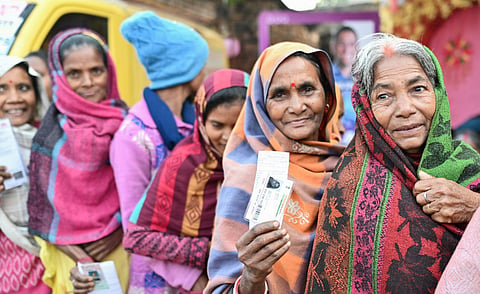

The Supreme Court on Thursday declined to entertain a Public Interest Litigation (PIL) seeking directions to make voting compulsory in India, observing that such a mandate falls within the “policy domain” and cannot be issued by the judiciary.
A bench comprising Chief Justice Surya Kant and Justices Joymalya Bagchi and Vipul M Pancholi asked petitioner Ajay Goel to approach the relevant stakeholders with his grievances.
A PTI report said that The court noted that requests for penal action against those who do not vote, as well as proposals to make voting mandatory, could not be adjudicated by the judiciary. The petitioner had also sought directions to the Election Commission to restrict government benefits for citizens who wilfully abstain from voting,
During the hearing, the Chief Justice said democracy is strengthened through awareness rather than coercion.
“In a country which is governed by the rule of law and believes in democracy, and where we have shown for 75 years how we trust and believe in it, everyone is expected to go (and vote). If they don’t go, they don’t go. What is needed is awareness, but we cannot compel,” the CJI said.
The PTI report added that, responding to the suggestion that non-voters be denied government benefits, the Chief Justice questioned the logic of punitive measures for abstaining from voting.
“Should we direct their arrest? If a citizen doesn’t go for voting, what can we do,” the CJI asked.
The bench also referred to practical difficulties in enforcing mandatory voting, noting that election day responsibilities prevent many citizens from voting.
“If we accept this, then my brother Justice Bagchi would have to go to West Bengal to vote even though it is a working day,” the CJI said.
“Judicial work is also important,” Justice Bagchi added.
The court further highlighted concerns for economically weaker sections.
“If a person who is poor says, ‘I need to earn my wages, how do I vote?’ what should we say to them?” the bench asked, the report added.
The petitioner suggested that the Election Commission be directed to form a committee to recommend restrictions on those who do not vote.
“We are afraid these issues lie in the policy domain,” the CJI said.
(With inputs from PTI)
