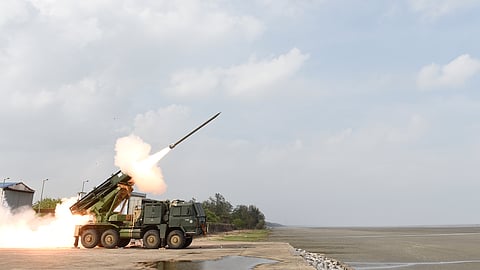

NEW DELHI: The Indian Army has initiated the process to develop an indigenous, network-centric fire control system that could fundamentally transform the way its artillery and missile units operate, plugging critical gaps in real-time battlefield integration.
The Army’s Directorate General of Information Systems (DGIS) has issued a Request for Information, the first step in the tendering process, for the development of a Land Vectors Control & Coordination System (LVCCS). The system is designed as a digital backbone to integrate all land-based strike assets, from guns and howitzers to rockets, missiles and loitering munitions, into a single, automated grid.
According to the document accessed by The New Indian Express, the system is intended to “automate all operational aspects of kinetic strikes… from observation, target acquisition, planning, delivery and post strike damage assessment,” compressing what is currently a fragmented process into a near real-time cycle.
At present, artillery operations rely on multiple layers of human intervention. Inputs from drones, radars or observation posts are processed at command posts, where decisions on target prioritisation, weapon allocation and fire planning are made before orders are passed to firing units. Existing systems such as the Battlefield Surveillance System and Command Information and Decision Support System provide inputs, but their linkage with firing elements is not seamless or uniformly automated, resulting in longer decision cycles and sub-optimal utilisation of firepower in high-tempo operations.
In contemporary conflicts, where speed and data fusion are critical, compressing the sensor-to-shooter cycle has become decisive, making such integrated systems increasingly essential.
Subsequently, LVCCS is looking at addressing these gaps. The Army has outlined a system that will provide both “technical control to deliver fire… quickly and accurately when it is required and where it is required” and “tactical control to achieve optimum utilisation of resources,” outlining a shift towards more automated, data-driven decision-making.
The architecture mandates seamless integration with the broader C4I2 grid (Command, Control, Communications, Computers, Intelligence and Interoperability) and with existing battlefield surveillance and decision-support systems.
Technically, the project is complex since it is meant to be flexible. The system will be modular and hardware-agnostic, with “commonality of hardware and software at all levels,” allowing upgrades without the need for a complete redesign. A strong emphasis is on Geographic Information System (GIS) integration, which will help commanders visualise terrain, plan deployments, assess lines of sight and map targets and firing data in real time. Information entered into the system will update automatically across platforms, ensuring that “data added… automatically” appears in the GIS display and vice versa.
Moreover, the networking layer will operate across satellite, radio, line and LAN (local area network) communications with encrypted links compliant with Army cybersecurity norms, while incorporating “intelligent self-learning network management” features. The system will initially be tested as a proof of concept at the regiment level, including integration of 155mm Bofors guns and Smerch rocket systems, before scaling across formations.
Importantly, the Army has mandated full indigenous development under the ‘Make in India’ framework, with intellectual property (IP) rights and source code ownership retained by the service. The platform is envisaged as a “live system which will continue to evolve” over a 10-year service life, with continuous upgrades built into its lifecycle.
The move reflects a broader doctrinal shift. While the Indian Air Force has long operated the Integrated Air Command and Control System (IACCS), a nationwide network that fuses sensor inputs into a common operational picture, the Army’s strike elements continue to function through a mix of legacy systems, manual coordination and partially digitised tools. Though efforts like AkashTeer have begun to network air defence units, offensive firepower remains less tightly integrated.
