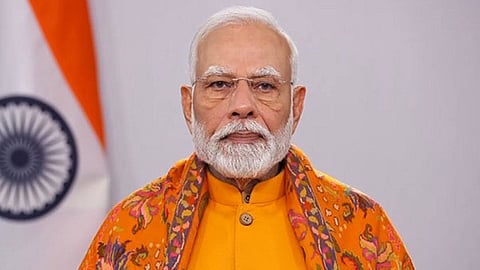

Prime Minister Narendra Modi on Sunday said the ongoing Census exercise is not just a government task but a shared responsibility of all citizens, stressing that widespread participation is vital for its success.
Addressing the nation in his monthly radio programme ‘Mann Ki Baat’, Modi assured that all information provided during the Census will remain secure and confidential, protected by robust digital systems.
“Friends, the national Census is not just a government task; it is a responsibility for all of us. Your participation is vital. The information you provide remains completely secure and confidential,” he said.
Describing it as one of the most important ongoing national exercises, Modi noted that India’s Census is the largest such exercise in the world and that Census 2027 is being conducted in a fully digital format.
“All information is being recorded directly through digital means,” he said, adding that enumerators visiting households are equipped with mobile applications to capture data in real time.
He also highlighted a new self-enumeration feature, allowing citizens to submit their details online up to 15 days before an official visit. Once completed, individuals will receive a unique ID via mobile or email, which can be shown to enumerators for verification, eliminating the need to provide information twice.
“In states where self-enumeration has been completed, house-listing work has already begun. So far, around 1.2 crore families have been covered,” he said, adding that the process this time would be significantly different for those who have participated in earlier censuses.
In the same address, Modi hailed the achievement of criticality at the fast breeder reactor in Kalpakkam as a “historic milestone”, saying India’s nuclear scientists have strengthened the country’s long-term energy security.
He said the 500 MWe Prototype Fast Breeder Reactor (PFBR) attaining first criticality, the start of a controlled fission chain reaction, marks a major step forward in India’s civil nuclear programme.
Calling it a landmark in India’s nuclear energy journey, he noted that the reactor has been built entirely using indigenous technology and recalled witnessing its core loading in March 2024.
Fast Breeder Reactors are central to India’s long-term nuclear strategy. The PFBR uses uranium-plutonium mixed oxide (MOX) fuel and is designed to eventually utilise thorium-232, converting it into uranium-233 for the third stage of India’s nuclear programme.
Modi also highlighted progress in renewable energy, noting that India’s wind energy capacity has crossed 56 gigawatts, with nearly 6 gigawatts added in the past year.
Union Minister Pralhad Joshi had earlier said India recorded its best-ever year in wind capacity addition during 2025-26, with 6.1 GW added. The country currently ranks fourth globally, with over 56.1 GW installed capacity and another 28 GW under implementation.
Joshi also pointed out that India’s wind energy potential at a hub height of 150 metres is estimated at nearly 1,164 GW, expressing confidence that the country will reach 100 GW by 2030 and 156 GW by 2036, contributing to its net-zero target by 2070.
He added that wind energy plays a key role in stabilising the power system, with nearly 45 per cent of generation occurring during peak demand hours, complementing solar power effectively.
(With inputs from PTI)
