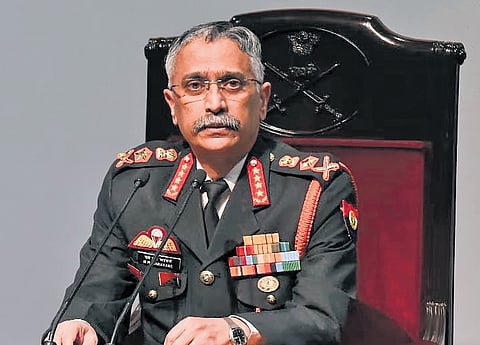

His book is written for readers who seek insight into what makes the Indian armed forces tick, combining clear language with wit. The newly released work by ex-Army chief General Manoj Mukund Naravane, ‘The Curious and the Classified —Unearthing Military Myths and Mysteries’—takes readers into the esprit de corps of the armed forces. It explores themes such as their apolitical character, discipline, the “duality” of ranks, and traditions like the “Jai Hind” salute, popularised by the Air Force.
The book also delves into the military’s distinctive culture—its humour, logistical ingenuity, and battlefield slang and acronyms (AWOL, SNAFU, FUBAR, MIA, PTSD), as well as customs of the officers’ mess and colloquial expressions like do bottle, teen glass and chak de phatte. These elements are interwoven with true-life anecdotes in the book, the third in a row including his yet-to-be published autobiography, Four Stars of Destiny.
Earlier this year, Rahul Gandhi, Leader of the Opposition in the Lok Sabha, was prevented from referring to portions of the memoir in Parliament, as it had not yet been officially released. The publisher, Penguin Random House, clarified that the book had neither been published nor distributed at the time, and warned that any circulating copies—print or digital—were unauthorised and constituted copyright infringement.
Gen Naravane spoke to TNIE about ‘The Curious and the Classified’, the culture of the armed forces, the threat India faces from its eastern adversary, China, and the controversy around his unpublished memoir.
Excerpts:
‘The Curious and the Classified’ brings to light military heroes such as Rifleman Jaswant Singh Rawat of the Garhwal Rifles immortalised for his role in the 1962 India-China war; Rifleman Badluram of Assam Regiment, on whom the regiment’s anthem is based; and Baba Harbhajan Singh of Punjab Regiment, whose spiritual presence is believed to endure even today, with a chair left vacant for him during flag meetings between India and China. The book offers a lucid insight into various aspects of the armed forces and what makes them tick. Your thoughts.
I enjoyed writing it. I must thank my wife Veena for it. Before I sat down to write it, she had cautioned me against writing military history or a policy document. She asked me to keep the language and style simple and engaging. I had a couple of ideas, which I discussed with my friends in the Army. They did not know many of the stories. This encouraged me to write the book on what makes the armed forces tick.
You mention Post-traumatic stress disorder as a serious issue affecting many veterans—could you expand on that?
I used to joke with friends that each time I heard a firecracker during Diwali I looked for cover. Whenever a tire burst happened, I would look around for the source of sound. Any loud sound signalled danger.
The chapter on ‘Do bottle, Teen glass’ culture of bonhomie among officers, despite their rank and position in a hierarchical organisation, is endearing.
Yes. It served as a bonding among officers and created the much-needed space. Three officers irrespective of their rank and posting bonded over two bottles of beer and three glasses as a reminder that despite its hard exterior the army is ultimately made up of ordinary men and women with their strengths and weaknesses. But sadly, now this culture is possibly on the wane because of lesser strength of officers. Everyone is hard pressed for time.
Has the controversy surrounding your memoir, ‘Four Stars of Destiny’, affected you personally?
There is no controversy. Penguin issued an official clarification on it. My autobiography has been put on hold and is being vetted by the Ministry of Defence. Readers and the common public should understand that the book that was flashed (in Parliament) was fake because it was not published. They should have asked where the book came from. I have moved on since and written two books—’The Cantonment Controversy: A Military Thriller’ and ‘The Curious and the Classified’. I am writing a sequel to the ‘Cantonment Conspiracy’.
Why do people live in the past? Move on.
You mentioned experiencing a sense of loneliness at the top while serving as Chief of the Army Staff during the 2020 India-China face-off. Please elaborate.
Loneliness of command has been spoken and written about at length in almost all battles. Famously, Gen Dwight Eisenhower as the supreme Allied commander was struck by the loneliness and isolation of a commander before making the momentous decision of D-Day invasion in June 1944. When you are at the top you are aware that success or failure of an operation rests on your individual decision. This did not mean that I didn’t have the support of my higher ups. Loneliness at that point didn’t mean that I was abandoned or isolated.
Before planning military operations, we have multiple deliberations, which are run through the chain of command, including the RM (Raksha Mantri), CCS (Cabinet Committee on Security), NSA (National Security Advisor), at the highest level. There are also occasions when you have to take spot decision and you cannot deter or defer. Once a decision is taken everyone comes along. That night, in August 2020 I realised that the time to test my years of military training has come and I had to take a call. It was a defining moment.
What did the RM’s direction to you—’Jo uchit samjho wo karo’—mean?
It meant that I had the freedom to carry out the military operation within the given timeframe. There was time for action. It was not a knee jerk reaction. We contemplated for half an hour and there was back and forth communication. We stopped PLA in their tracks. We didn’t lose any territory. It was a whole of nation effort.
China continues to pose a constant threat to India. How do you think we can address this challenge?
We have an unresolved boundary issue with them. The LAC is not clearly marked and there is a difference of perception. We must negotiate hard to build better relations with PRC. One of the proposals the Chinese had floated in the 1950s was that they keep Aksai Chin and we keep Arunachal Pradesh. But the legality behind such a proposal needs to be examined.
There have been attempts to politicise the Army? Your comments.
The Indian Army is one of the most democratic organisations in the world. We are trained to be battle hardened and there is a chain of command that we must follow. There are serious and mature deliberations with the RM, CCS. That’s how the higher defence organisation is structured. That does not mean that the army is politicised.
You end your book by signing off with “PPC” (pour prendre congé), French for “to take leave” or “farewell.” How does a former COAS relax?
I play with my grandson.
